 NUILab
Three IEEE ISMAR 2026 Workshops, One Mission: Improving People’s Everyday Life with Extended Reality
The lab has three workshop papers at IEEE ISMAR 2026 in Bari, Italy, each in a different workshop. The linked PDFs are preprints, not versions of record.
1. Beyond the Beep: Comparing Visual-Only and Multimodal Notification Design for Improved Noticeability in AR — Aditya Raikwar, Zahra Borhani, Lucas Plabst, Anil Ufuk Batmaz, Mayra Donaji Barrera Machuca, Florian Niebling, and Francisco Raul Ortega. Preprint (PDF) (opens in new tab)
Alt’ISMAR’26 — Alternative ISMAR, a workshop at IEEE ISMAR 2026 (Tuesday 6 October, afternoon) for unconventional, critical, or speculative XR work, including negative results.
2. Virtual Reality Forest Bathing for Mental Health — Rachel Masters and Francisco Ortega. Preprint (PDF) (opens in new tab)
MARMH’26 — 7th International Workshop on Mixed/Augmented Reality for Mental Health, a workshop at IEEE ISMAR 2026 (Monday 5 October, morning) where XR researchers and clinicians present work on prevention, intervention, and ethics.
3. Does Virtual Reality Design Matter for Learning? A Study of Fluid Dynamics — Matthew J. Buckman, Zahra Borhani, Haley McCoy, Yue Dong, Yanlin Guo, Rebecca Atadero, Hannah Hausman, Matthew G. Rhodes, Marcia Moraes, and Francisco Raul Ortega. Preprint (PDF) (opens in new tab)
TeacXR’26 — 1st International Workshop on Teaching XR, a workshop at IEEE ISMAR 2026 (Tuesday 6 October, afternoon) on the pedagogy of spatial computing and how XR developers are trained.
The three papers look at extended reality in three ordinary settings: a person working a shift, a person under stress, and a student learning a hard concept. In all three, the most instructive results are negative: a notification cue that performed worst, evidence that does not yet exist, and an accurate simulation that did not improve learning.
Notifications without sound — Alt’ISMAR’26 at IEEE ISMAR 2026
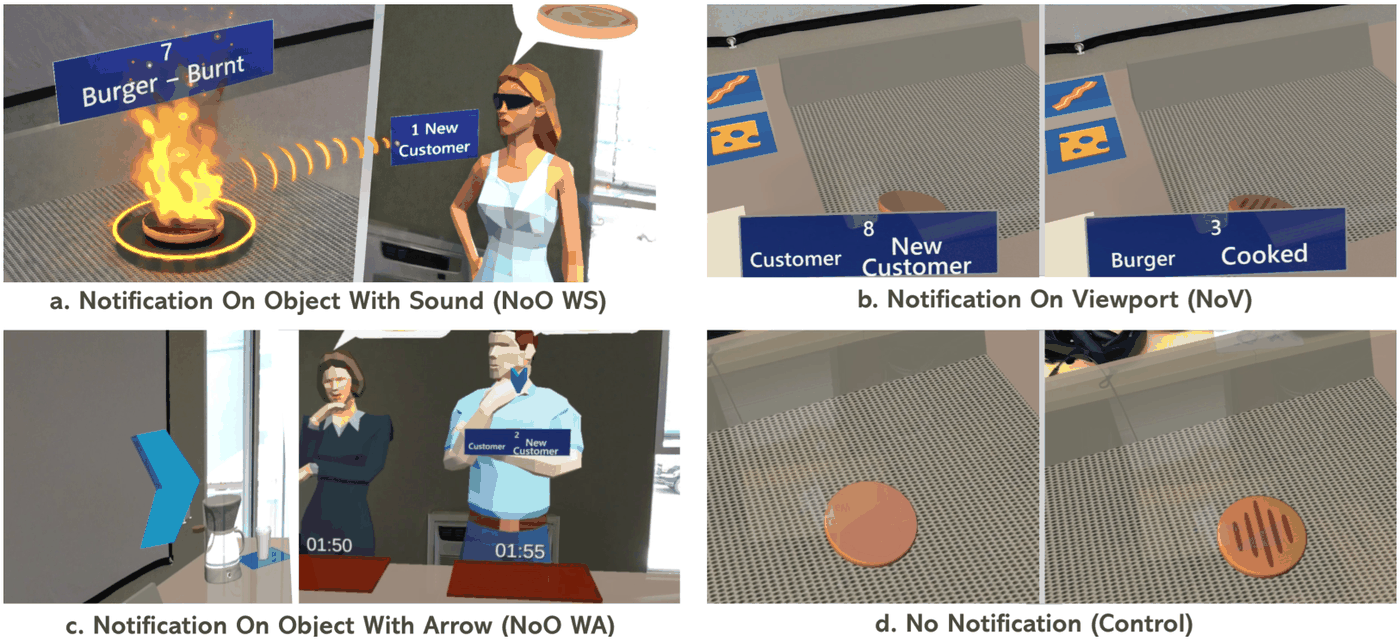
The four conditions in ARtisan Bistro: sound plus an on-object label (a), a label fixed to the bottom of the viewport (b), an on-object label with a peripheral arrow when the source is out of view (c), and no notification (d).
Our earlier work found that the best AR notification puts the label on the object it refers to and adds a short spatial sound. Many real workplaces cannot use that sound. A factory floor, a busy street, a hospital corridor, and a shared office all make audio unreliable or unwelcome. This study asked what a designer loses by removing it.
Twenty-four participants ran a virtual restaurant on a HoloLens 2 in ARtisan Bistro (opens in new tab) , our open-source AR environment. Each round had six customers and a 120-second limit per meal, with notifications often arriving from stations outside the participant’s line of sight. Everyone tried four designs in counterbalanced order: the on-object label with sound, a label fixed at the bottom of the field of view, an on-object label with an arrow at the edge of the view pointing toward off-screen sources, and no notifications at all.
Output did not distinguish the designs. Customers served did not differ significantly across the four conditions, including the condition with no notifications. The reason is visible in the data: 41.67% of rounds were perfect scores, and participants improved significantly with practice regardless of design, from 4.58 customers served on their first round to 5.37 on their third. The task was easy enough to master, so people adapted to a poor notification design and kept up.
Attention did distinguish them. Participants noticed 81.63% of notifications with sound, 76.78% with the fixed bottom label, and 68.53% with the arrow. They responded in 2.34 seconds with sound, 2.64 seconds with the fixed label, and 3.30 seconds with the arrow. Usability scores followed the same order: 80.00, 77.50, and 66.67, against 75.00 for no notifications. Perceived workload did not differ significantly across conditions, and participants ranked the sound design first most often (ten first-place votes, against eight for the fixed label, five for the arrow, and one for no notifications).
Three of those gaps were statistically significant: the sound design was noticed more often than the arrow, the arrow was slower than both other designs, and the sound design scored higher on usability than the arrow. The fixed bottom label was never significantly worse than the sound design on any of them.
What this means for anyone building AR for a noisy setting. A simple label anchored at the bottom of the view is a defensible fallback when audio is not an option. It kept pace with the multimodal design on both noticing and speed. The arrow is the cautionary result: it was designed specifically to solve the problem that sound solves, guiding attention to something outside the field of view, and it performed worst of the three on noticing, response time, and usability. It replaced a cue people process without effort with one they had to search and interpret. Participants said as much. P4: “The arrows felt a bit overwhelming. It felt like it was telling you to do a lot of stuff.” P12: “I think they (arrows) were too big, but I think the main thing is when they piled on top of one another, I’m like, I don’t even know where you are pointing anymore.”
A non-significant difference is not proof of equivalence, so the fixed label should not be called equal to the multimodal design. And the study did not actually add background noise; noise level and harder tasks are the next things to test.
What we still do not know about virtual nature — MARMH’26 at IEEE ISMAR 2026
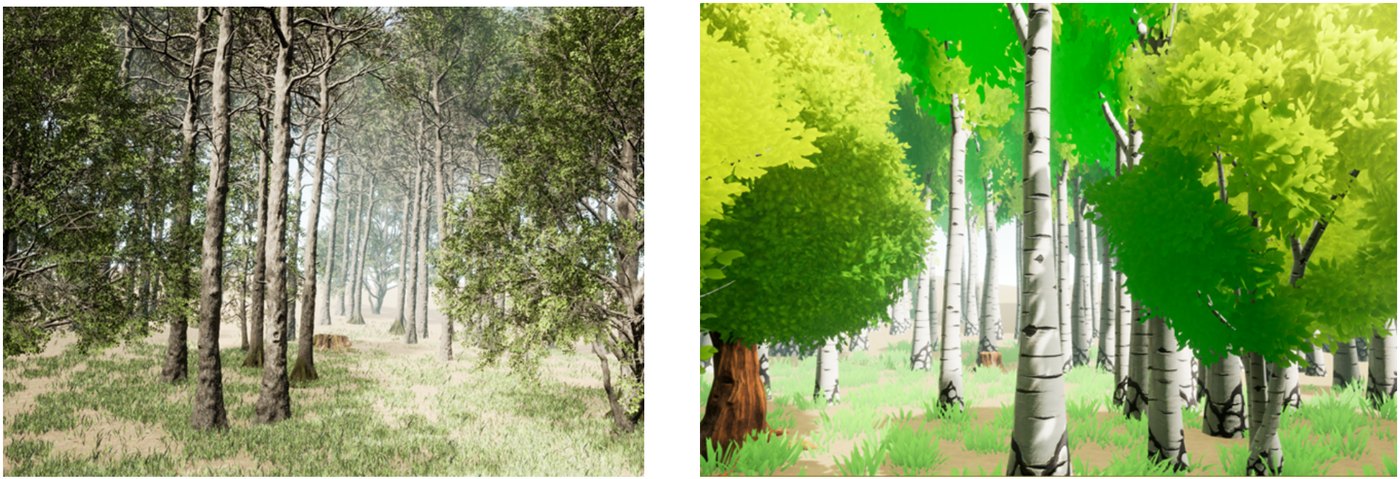
High- and low-realism nature environments from Masters et al. (2024). Restorative quality did not differ significantly between them.
This is a position paper rather than a new experiment, and its argument is directed at the people building and studying virtual nature for mental health.
The motivation is straightforward. Stress costs the global workforce about 12 billion working days a year, and roughly one billion people live with mental illness. Time in nature reduces stress and restores attention. The settings where people most need that relief, hospitals among them, are often the settings with the least reliable access to it. Virtual nature is a plausible supplement, and there are encouraging results with older adults, hospice family caregivers, people with mild-to-moderate anxiety and depression, and patients undergoing burn wound care.
The problem is what happens when a designer asks a practical question: what should actually go in the scene? The evidence to answer that barely exists. A review of 124 articles found that most virtual nature experiences were passive, that most used 360-degree video rather than 3D scenes a researcher can vary, and that only one study compared passive and active designs. A review of visual factors found six papers on geometry, three on lighting, two on material surfaces, and two on color. Across the literature, designs, measures, and controls differ enough that results do not accumulate.
Our own results are part of the evidence for that gap. Comparing high- and low-realism virtual forests produced no significant difference in restorative quality, though participants trended toward preferring the realistic version. An earlier comparison of green and brown environments also found no significant difference and was limited by cybersickness. A separate study by another group found a natural area scored significantly lower than urban and semi-urban parks on positive affect and perceived restorativeness, but the amount of greenery was not held constant.
What this means. There is not yet enough evidence to specify a restorative virtual environment with confidence, and the common instinct to maximize realism has a cost: heavier scenes run poorly on standalone headsets and induce cybersickness, which then contaminates the very measurements the study depends on. The paper sets three priorities. Test properties a researcher can control precisely, down to the quantity of rocks, trees, or moss, and include places people cannot easily visit, such as caves and underwater settings. Study how people perceive virtual nature compared with real nature and with stylized digital worlds. Examine how culture, upbringing, past environments, and personal preference change what restores a given person. Throughout, the paper treats virtual nature as a supplement where access to real nature is limited, not as a replacement for it.
An accurate simulation is not a lesson — TeacXR’26 at IEEE ISMAR 2026
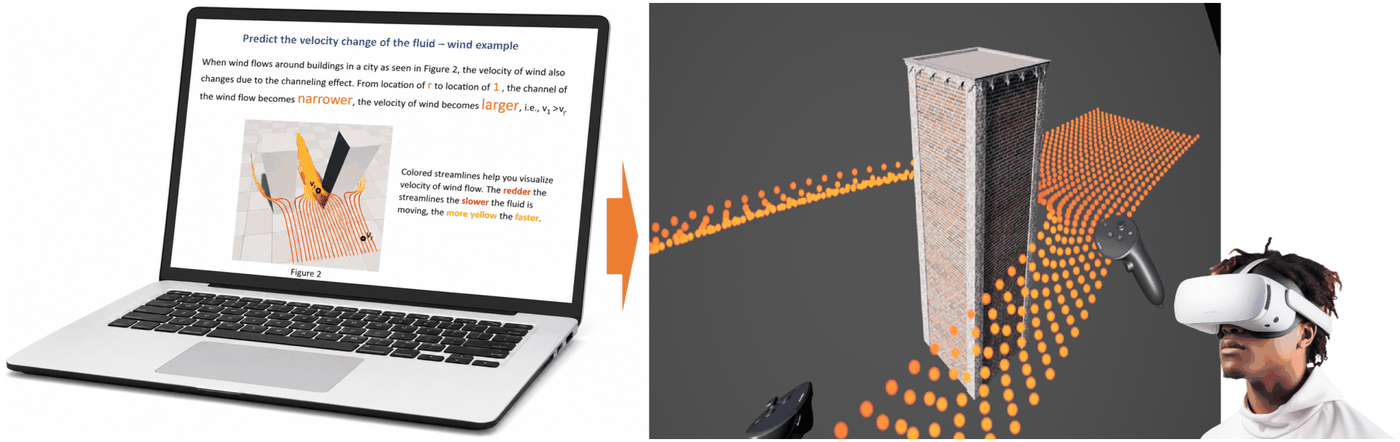
The two conditions. Both groups first studied the same slides; one group then reviewed the slides again, the other used the VR wind simulation.
Fluid dynamics is a good test of the case for educational VR. The behavior is invisible, students routinely misread the inverse relationship between pressure and velocity, and the usual alternatives are poor: wind tunnels are expensive and many institutions have none, while CFD software demands expertise beginners lack and usually shows a moving three-dimensional flow on a flat display, often at a single time point. Making that flow visible and explorable is exactly what VR should be good for.
The simulation itself was carefully built. A CFD specialist modeled wind around a high-rise building approximately 24 stories tall in ANSYS Fluent. The team sampled a single time interval of the velocity and pressure data, converted it to fluid grid ASCII format, and drove a particle visualization in Unreal Engine 5.2 on a Meta Quest Pro. Participants could teleport between viewpoints, move the airflow source, switch the visualization between streamlines and dots, and read explanations in place; rotating the building and changing the smoke height unlocked at the final slide.
Thirty-one participants took part. Everyone studied the same eleven slides for ten minutes. The control group then answered five minutes of distractor questions and reviewed those slides for ten more minutes. The VR group instead had a five-minute headset tutorial and ten minutes in the simulation. Both groups took the same fifteen-question quiz, each item showing a flow with two labeled points and asking which had higher velocity or pressure.
The control group scored higher on every measure: 83% against 68% overall, 91% against 70% on questions both groups had equal exposure to, and 90% against 68% on questions neither group had seen during learning. All three differences were statistically significant, with effect sizes from medium-to-large to large (d = 0.86 to 1.03).
What this means, and what it does not. It does not mean VR fails at teaching. The two conditions differed in more than the display. The slides were developed iteratively by engineering instructors and learning scientists applying multimedia learning and cognitive load principles. The VR module was built by a VR specialist and optimized for an accurate three-dimensional rendering of real data, without the same instructional-design work. The control group also saw the slide material twice, and a few quiz items used water examples that appeared in the slides but not in VR, though the paper argues the answers do not depend on which fluid is shown.
The result is a warning about where effort goes. Technical accuracy and instructional quality are separate investments, and the VR side received far less of the second. A review the paper cites found that 68% of VR education studies never stated a theoretical foundation for how their application was structured. The paper’s recommendations follow from that: build on a theoretical learning framework, apply best-practice design principles, and choose interaction techniques that keep the effort of moving and manipulating low so attention stays on the concept.
A separate post covers our gesture elicitation work at the main IEEE ISMAR 2026 conference .
The three PDFs are preprints, not versions of record: Beyond the Beep (PDF) (opens in new tab) · Virtual Reality Forest Bathing for Mental Health (PDF) (opens in new tab) · Does Virtual Reality Design Matter for Learning? (PDF) (opens in new tab). We will link the published versions when they appear.
The notification and fluid dynamics work was supported by NSF awards 2439474, 2444132, 2327569, 2238313, and 2223432. The forest bathing work was supported by the NSF Graduate Research Fellowship Program under Grant No. 23605.