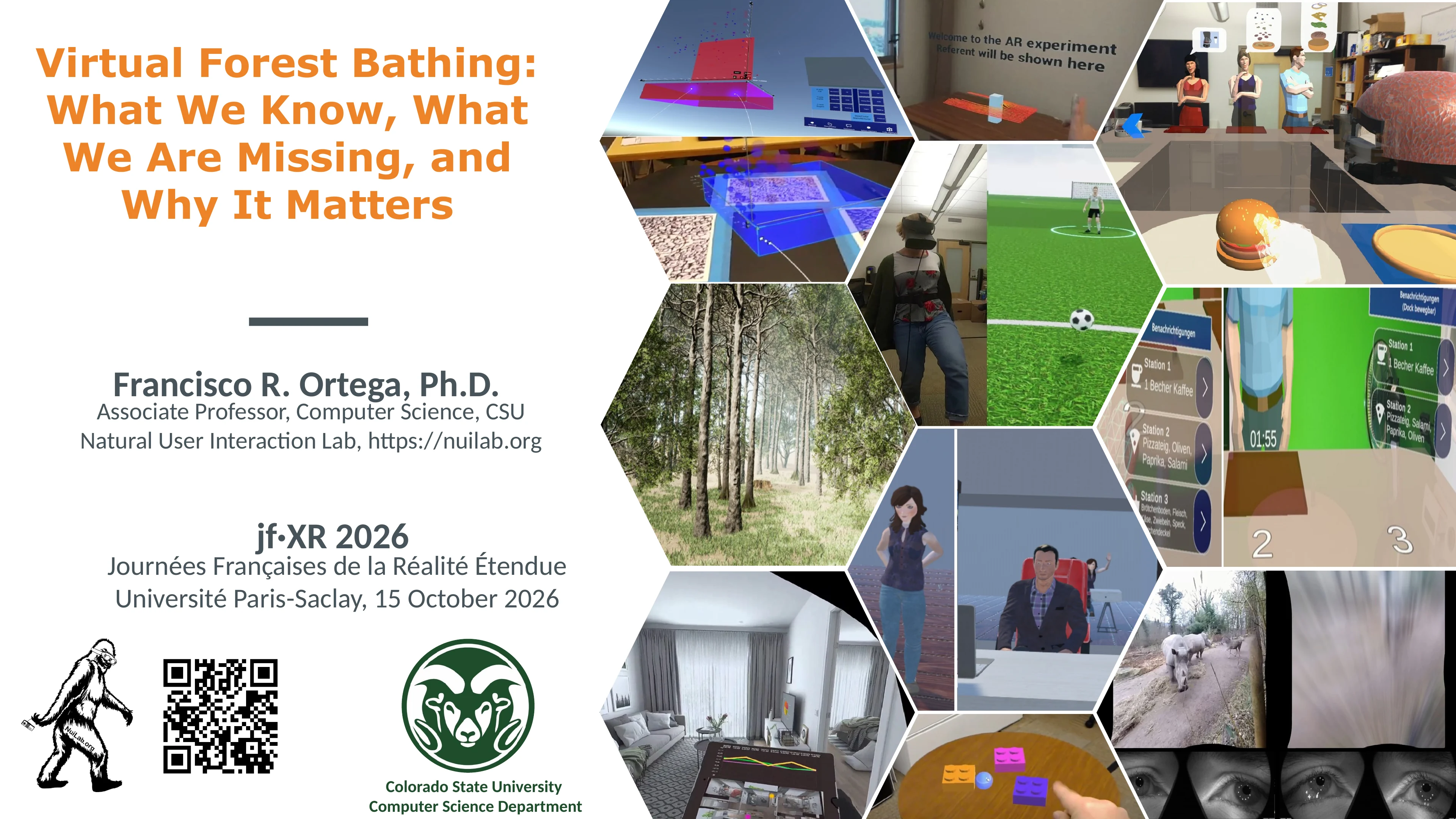
Colorado State University
Computer Science Department
http://nuilab.org/
Virtual Forest Bathing: What We Know, What We Are Missing, and Why It Matters
Francisco R. Ortega, Ph.D.
Associate Professor, Computer Science, CSU
Natural User Interaction Lab, https://nuilab.org
jf·XR 2026
Journées Françaises de la Réalité Étendue
Université Paris-Saclay, 15 October 2026
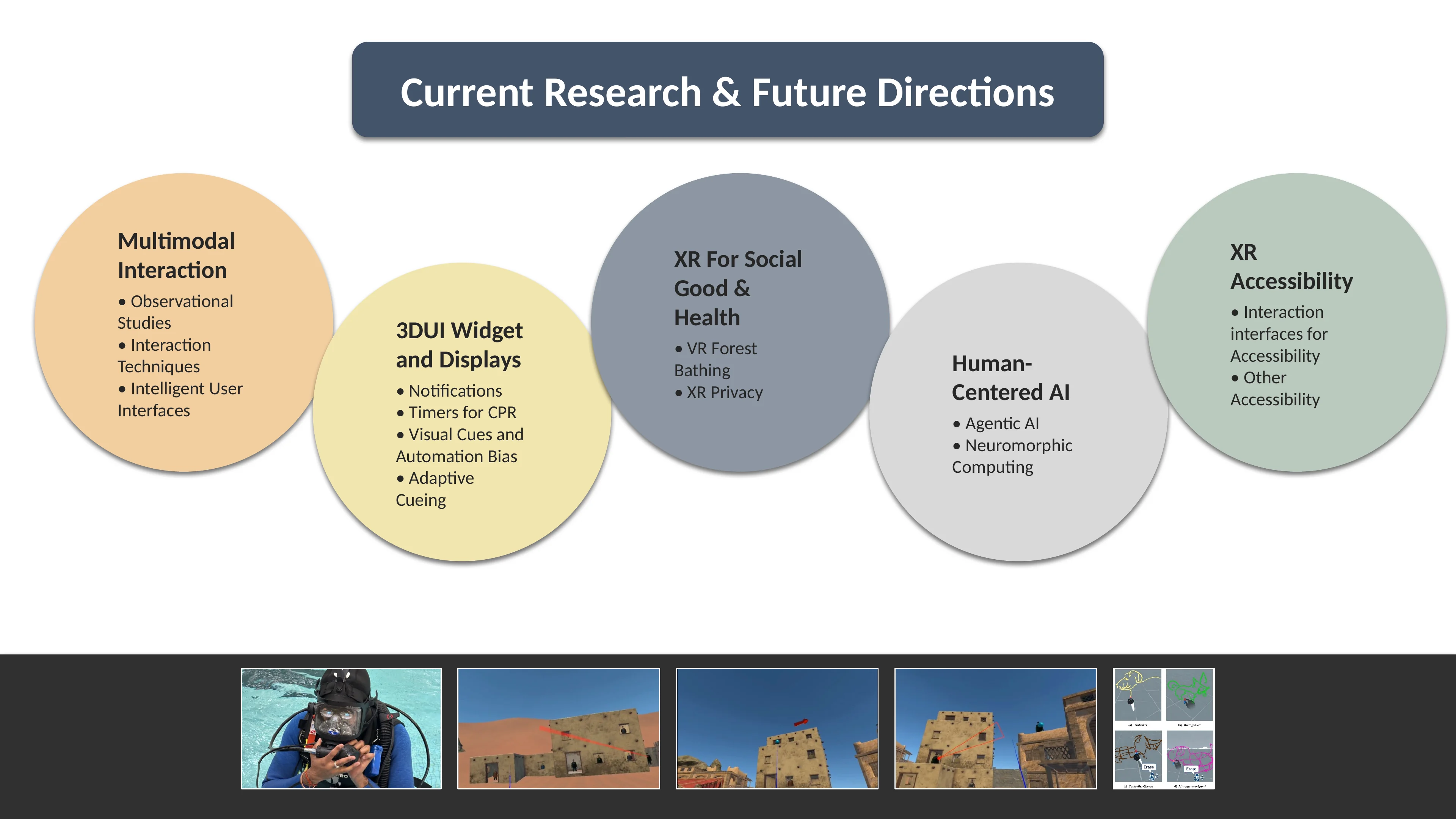
Current Research & Future Directions
Multimodal Interaction
• Observational Studies
• Interaction Techniques
• Intelligent User Interfaces
3DUI Widget and Displays
• Notifications
• Timers for CPR
• Visual Cues and Automation Bias
• Adaptive Cueing
XR For Social Good & Health
• VR Forest Bathing
• XR Privacy
Human-Centered AI
• Agentic AI
• Neuromorphic Computing
XR Accessibility
• Interaction interfaces for Accessibility
• Other Accessibility
The best research problem is the one i haven’t found yet!
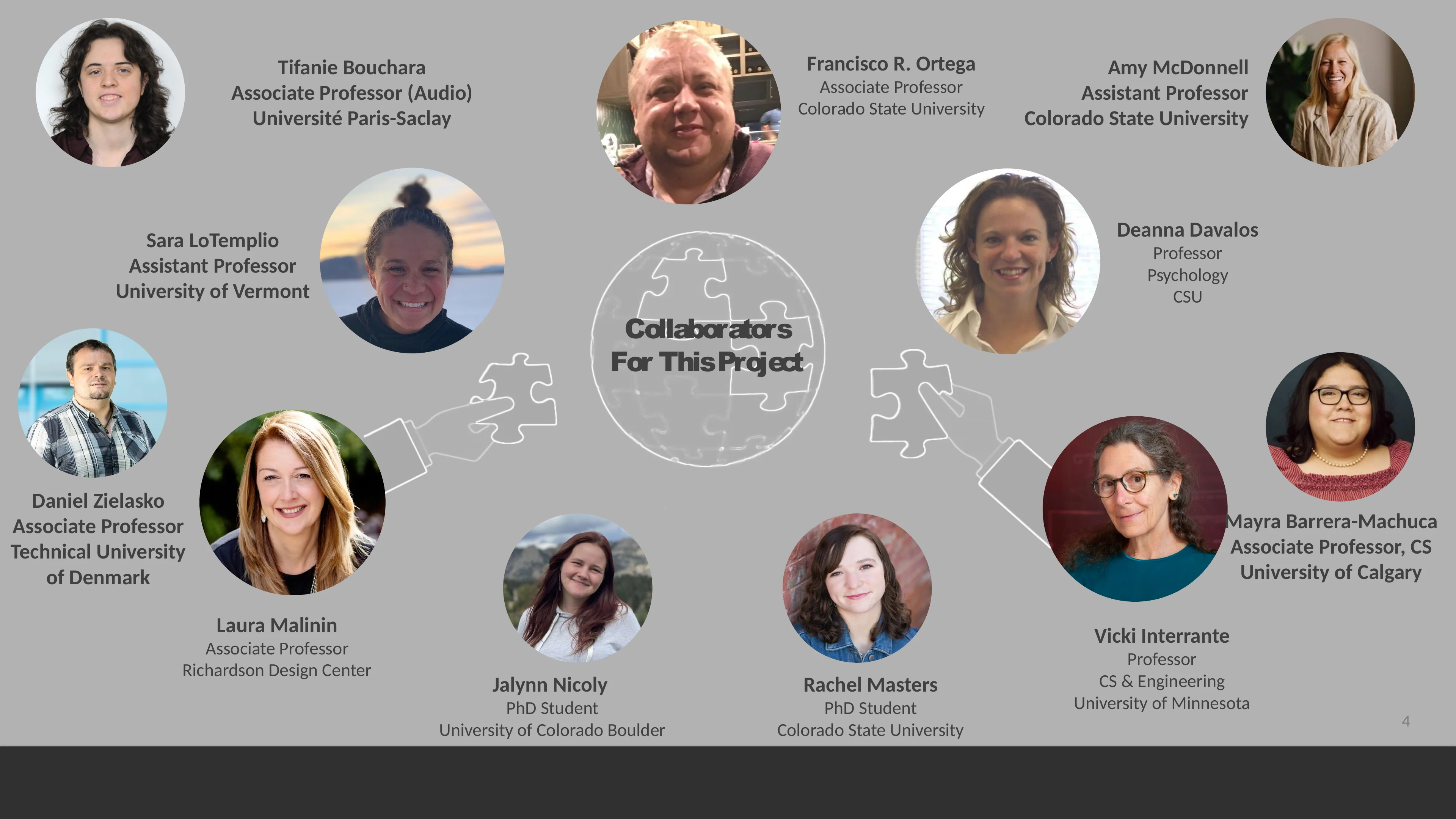
Vicki Interrante
Professor
CS & Engineering
University of Minnesota
Sara LoTemplio
Assistant Professor
University of Vermont
Collaborators
For This Project
Deanna Davalos
Professor
Psychology
CSU
Francisco R. Ortega
Associate Professor
Colorado State University
Rachel Masters
PhD Student
Colorado State University
Jalynn Nicoly
PhD Student
University of Colorado Boulder
Laura Malinin
Associate Professor
Richardson Design Center
Tifanie Bouchara
Associate Professor (Audio)
Université Paris-Saclay
Amy McDonnell
Assistant Professor
Colorado State University
Daniel Zielasko
Associate Professor
Technical University of Denmark
Mayra Barrera-Machuca
Associate Professor, CS
University of Calgary
4
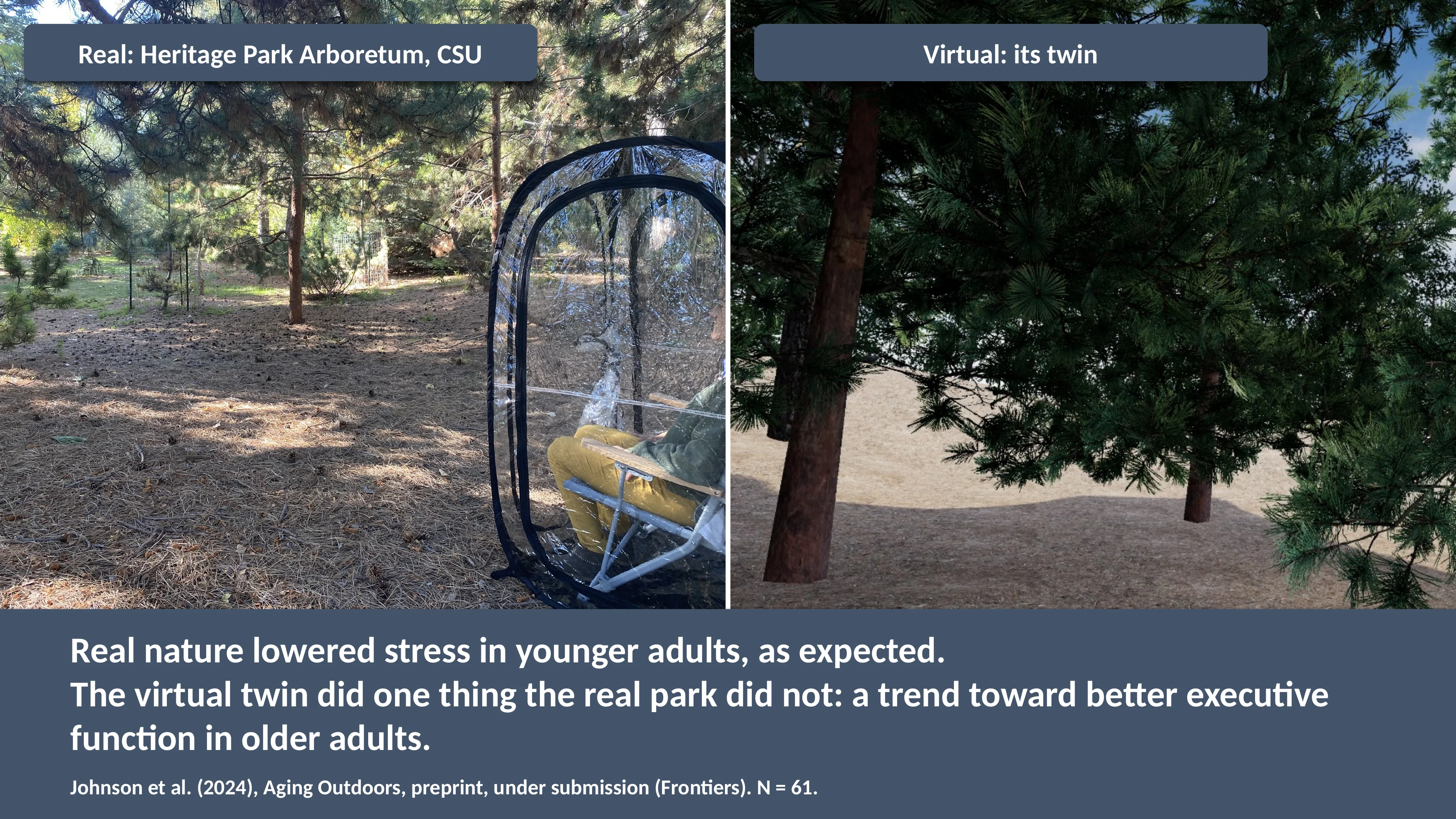
Real: Heritage Park Arboretum, CSU
Virtual: its twin
Real nature lowered stress in younger adults, as expected.
The virtual twin did one thing the real park did not: a trend toward better executive function in older adults.
Johnson et al. (2024), Aging Outdoors, preprint, under submission (Frontiers). N = 61.
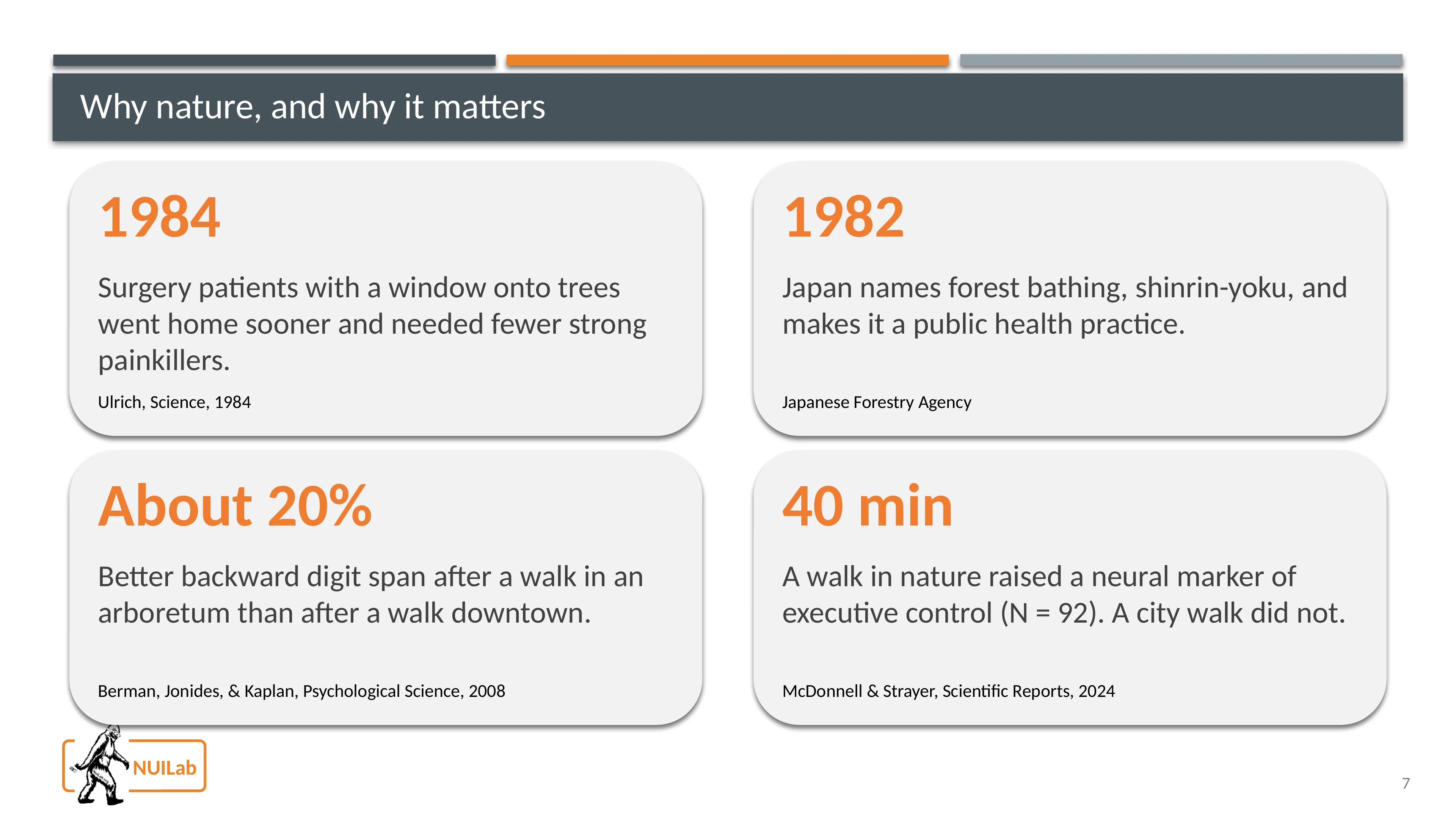
Why nature, and why it matters
1984
Surgery patients with a window onto trees went home sooner and needed fewer strong painkillers.
Ulrich, Science, 1984
1982
Japan names forest bathing, shinrin-yoku, and makes it a public health practice.
Japanese Forestry Agency
About 20%
Better backward digit span after a walk in an arboretum than after a walk downtown.
Berman, Jonides, & Kaplan, Psychological Science, 2008
40 min
A walk in nature raised a neural marker of executive control (N = 92). A city walk did not.
McDonnell & Strayer, Scientific Reports, 2024
7
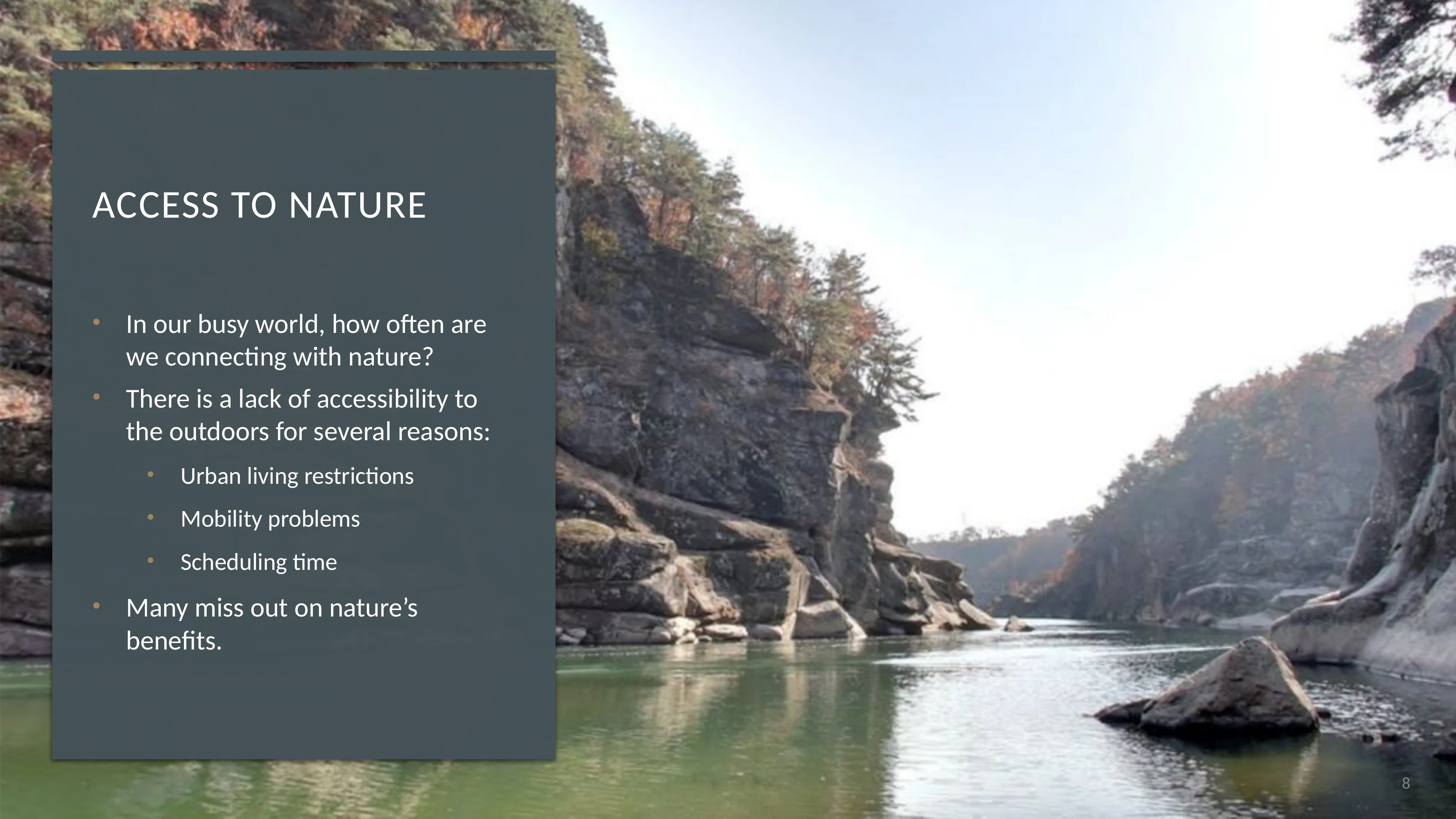
Access to nature
In our busy world, how often are we connecting with nature?
There is a lack of accessibility to the outdoors for several reasons:
Urban living restrictions
Mobility problems
Scheduling time
Many miss out on nature’s benefits.
8
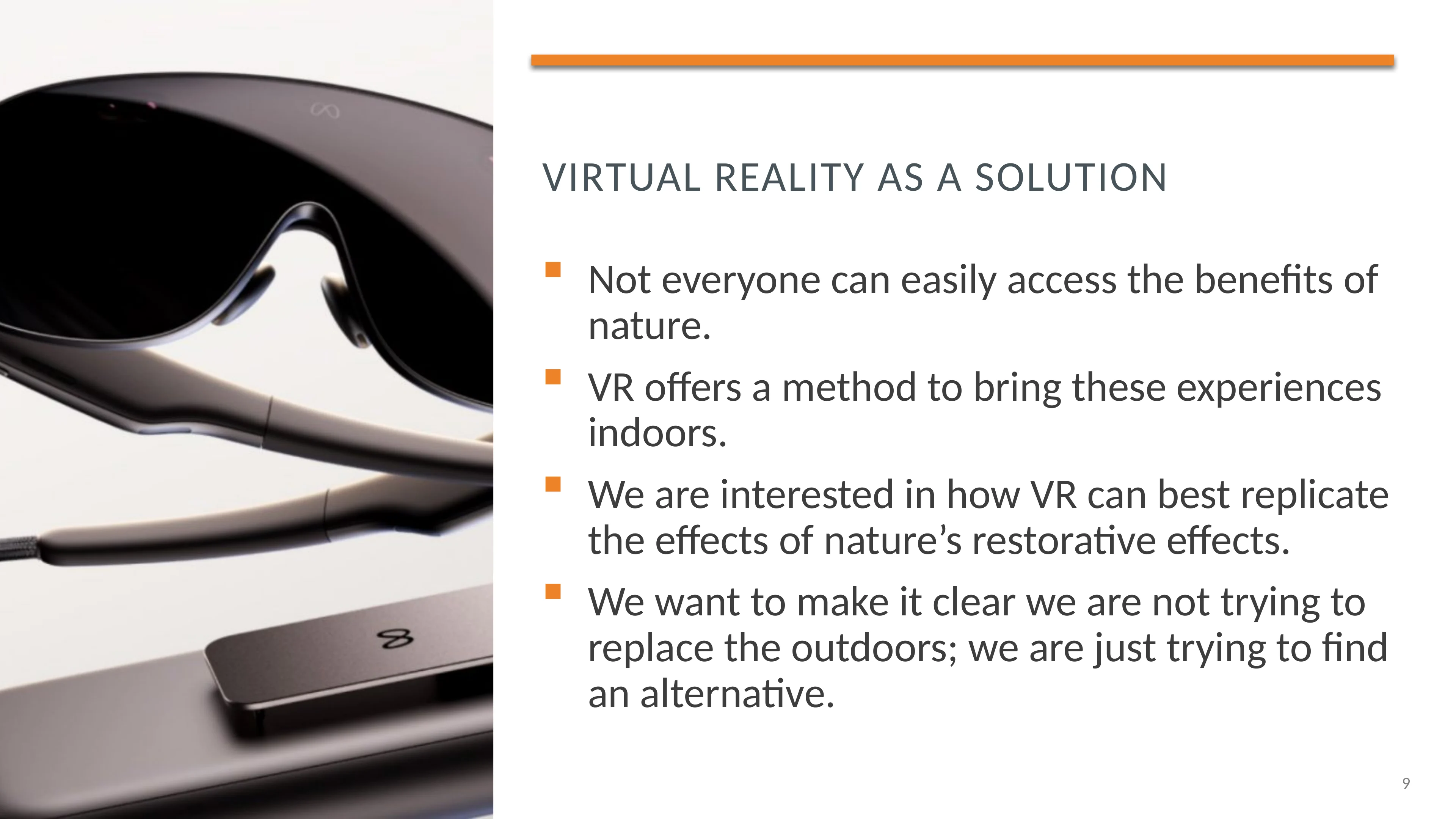
Virtual reality as a solution
Not everyone can easily access the benefits of nature.
VR offers a method to bring these experiences indoors.
We are interested in how VR can best replicate the effects of nature’s restorative effects.
We want to make it clear we are not trying to replace the outdoors; we are just trying to find an alternative.
9
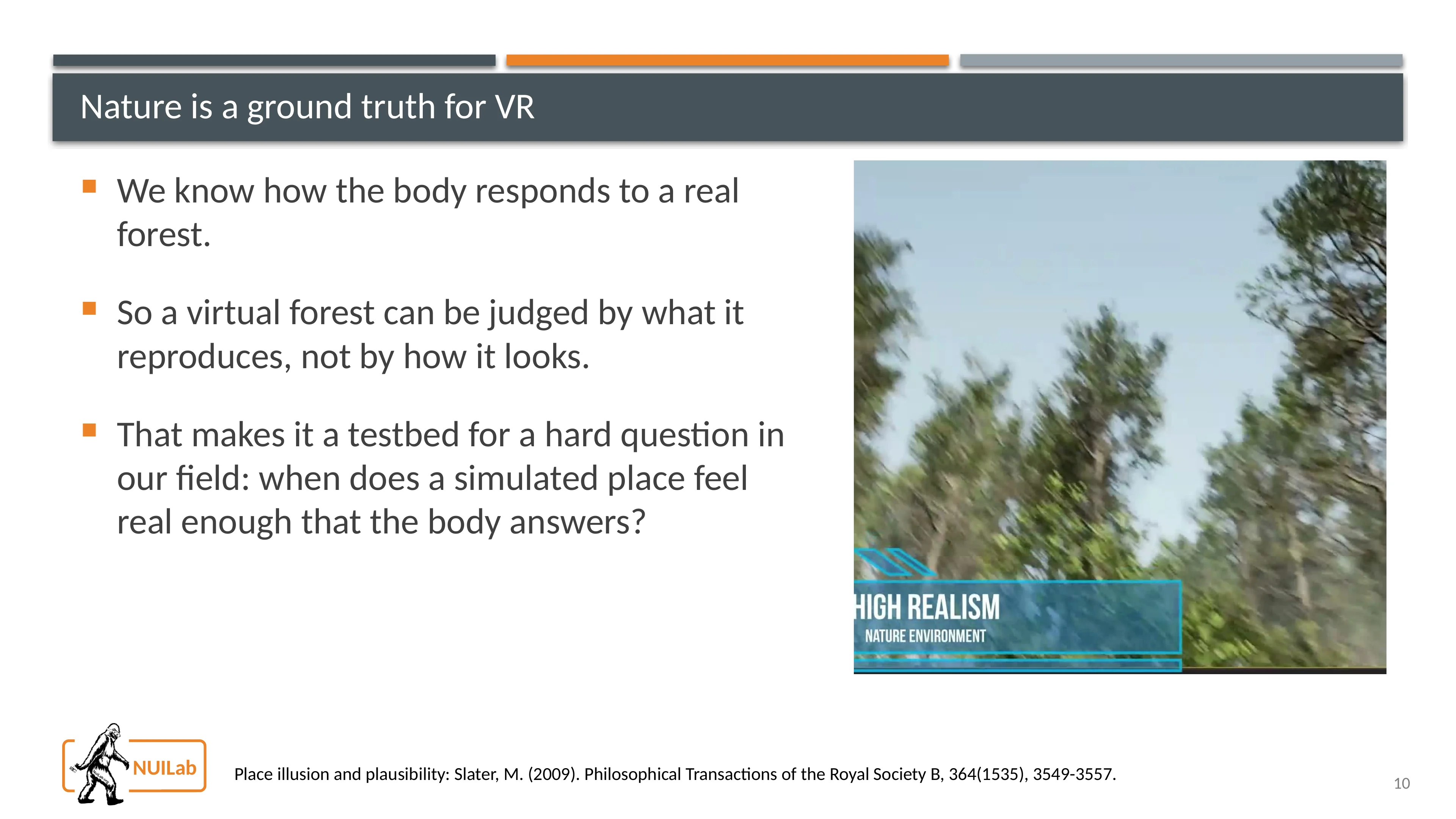
Nature is a ground truth for VR
We know how the body responds to a real forest.
So a virtual forest can be judged by what it reproduces, not by how it looks.
That makes it a testbed for a hard question in our field: when does a simulated place feel real enough that the body answers?
Place illusion and plausibility: Slater, M. (2009). Philosophical Transactions of the Royal Society B, 364(1535), 3549-3557.
10
Three parts
1
What we know
Six studies, more than 250 people
2
What we are missing
The senses, the person, the mechanism
3
Why it matters
Perception, older adults, promoting nature, the clinic
11
1
WHAT WE KNOW
Six studies, more than 250 participants, one question
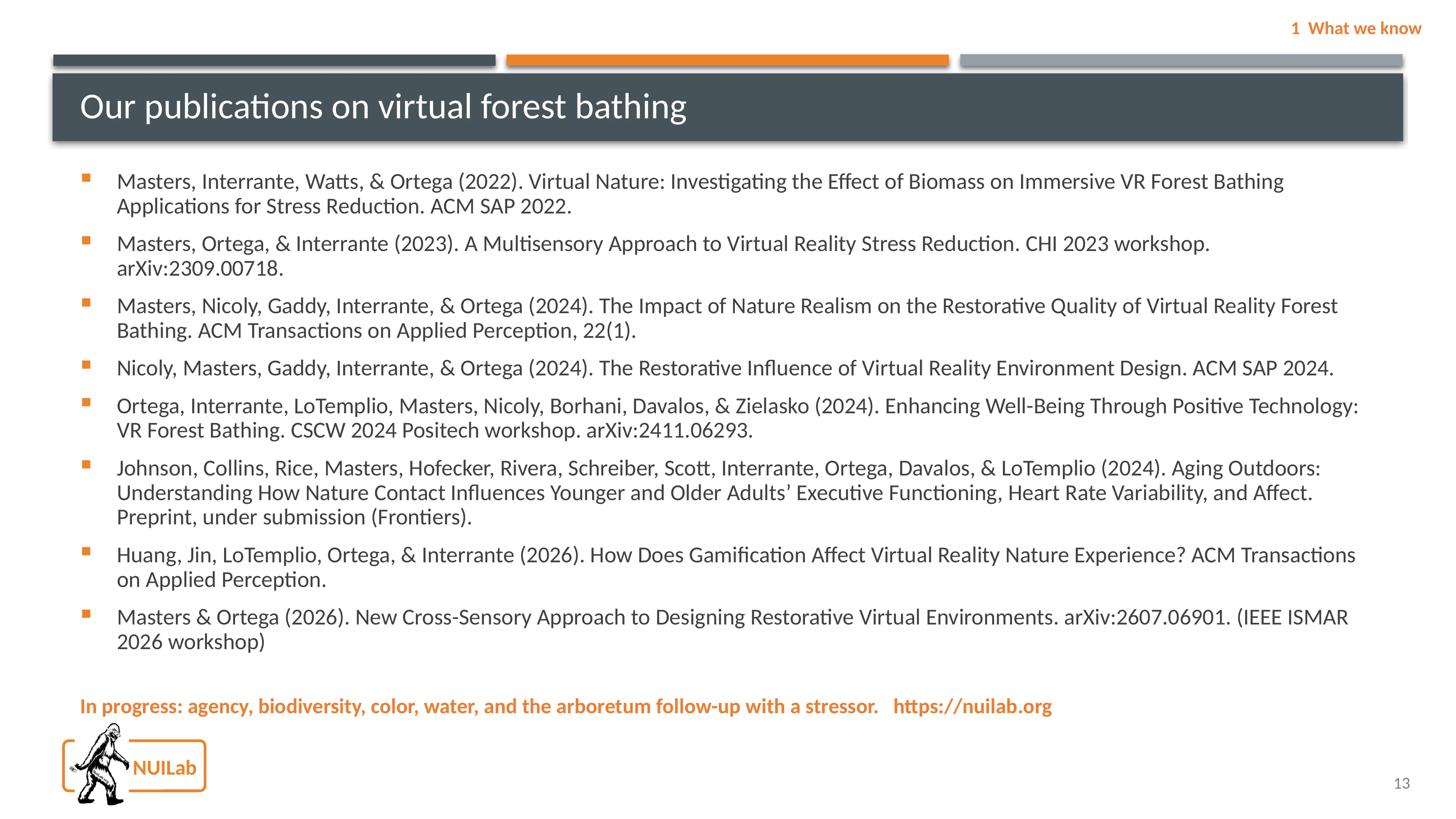
Our publications on virtual forest bathing
Masters, Interrante, Watts, & Ortega (2022). Virtual Nature: Investigating the Effect of Biomass on Immersive VR Forest Bathing Applications for Stress Reduction. ACM SAP 2022.
Masters, Ortega, & Interrante (2023). A Multisensory Approach to Virtual Reality Stress Reduction. CHI 2023 workshop. arXiv:2309.00718.
Masters, Nicoly, Gaddy, Interrante, & Ortega (2024). The Impact of Nature Realism on the Restorative Quality of Virtual Reality Forest Bathing. ACM Transactions on Applied Perception, 22(1).
Nicoly, Masters, Gaddy, Interrante, & Ortega (2024). The Restorative Influence of Virtual Reality Environment Design. ACM SAP 2024.
Ortega, Interrante, LoTemplio, Masters, Nicoly, Borhani, Davalos, & Zielasko (2024). Enhancing Well-Being Through Positive Technology: VR Forest Bathing. CSCW 2024 Positech workshop. arXiv:2411.06293.
Johnson, Collins, Rice, Masters, Hofecker, Rivera, Schreiber, Scott, Interrante, Ortega, Davalos, & LoTemplio (2024). Aging Outdoors: Understanding How Nature Contact Influences Younger and Older Adults’ Executive Functioning, Heart Rate Variability, and Affect. Preprint, under submission (Frontiers).
Huang, Jin, LoTemplio, Ortega, & Interrante (2026). How Does Gamification Affect Virtual Reality Nature Experience? ACM Transactions on Applied Perception.
Masters & Ortega (2026). New Cross-Sensory Approach to Designing Restorative Virtual Environments. arXiv:2607.06901. (IEEE ISMAR 2026 workshop)
In progress: agency, biodiversity, color, water, and the arboretum follow-up with a stressor. https://nuilab.org
1 What we know
13
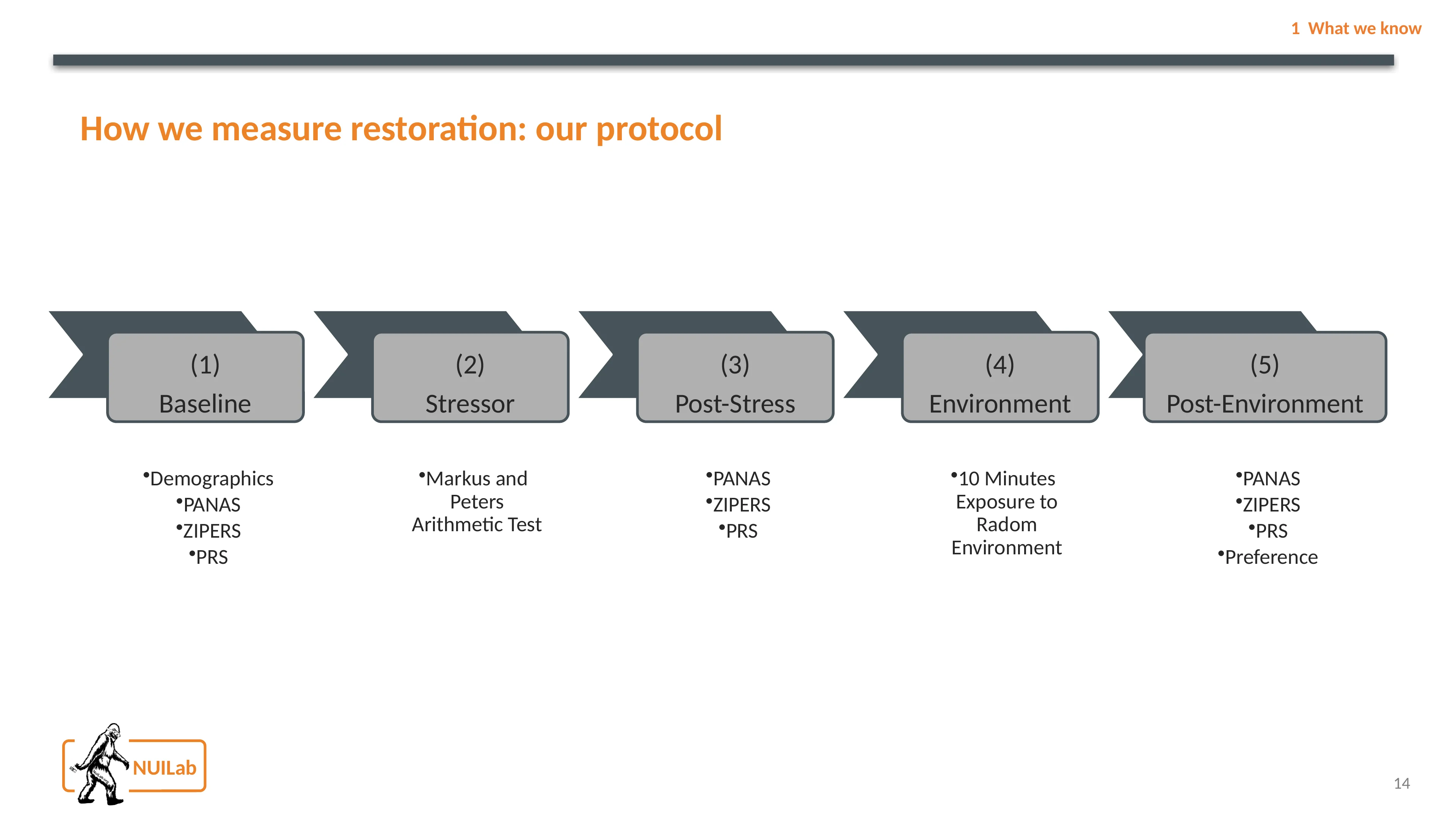
How we measure restoration: our protocol
1 What we know
14
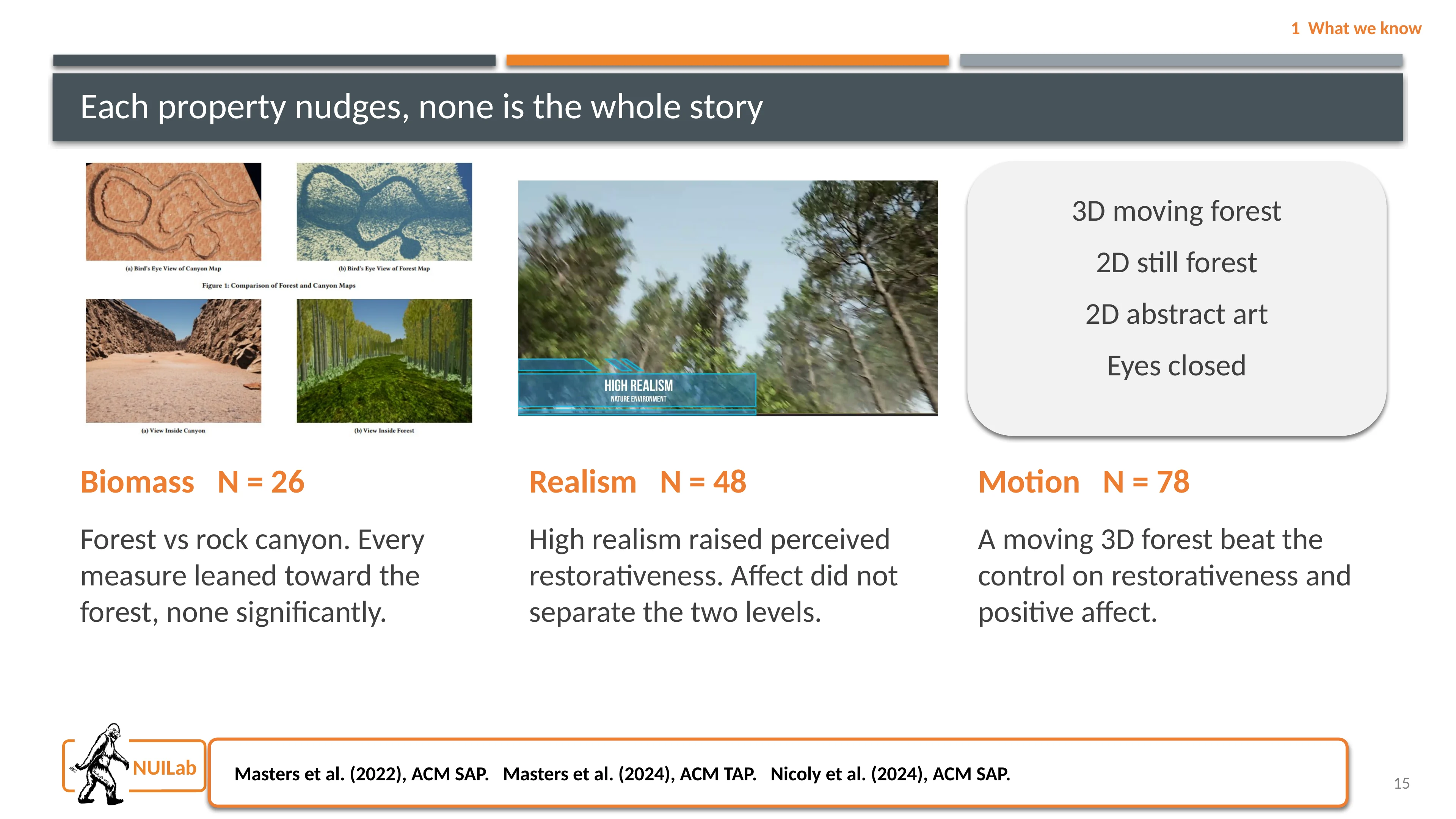
Each property nudges, none is the whole story
Biomass N = 26
Forest vs rock canyon. Every measure leaned toward the forest, none significantly.
Realism N = 48
High realism raised perceived restorativeness. Affect did not separate the two levels.
3D moving forest
2D still forest
2D abstract art
Eyes closed
Motion N = 78
A moving 3D forest beat the control on restorativeness and positive affect.
Masters et al. (2022), ACM SAP. Masters et al. (2024), ACM TAP. Nicoly et al. (2024), ACM SAP.
1 What we know
15
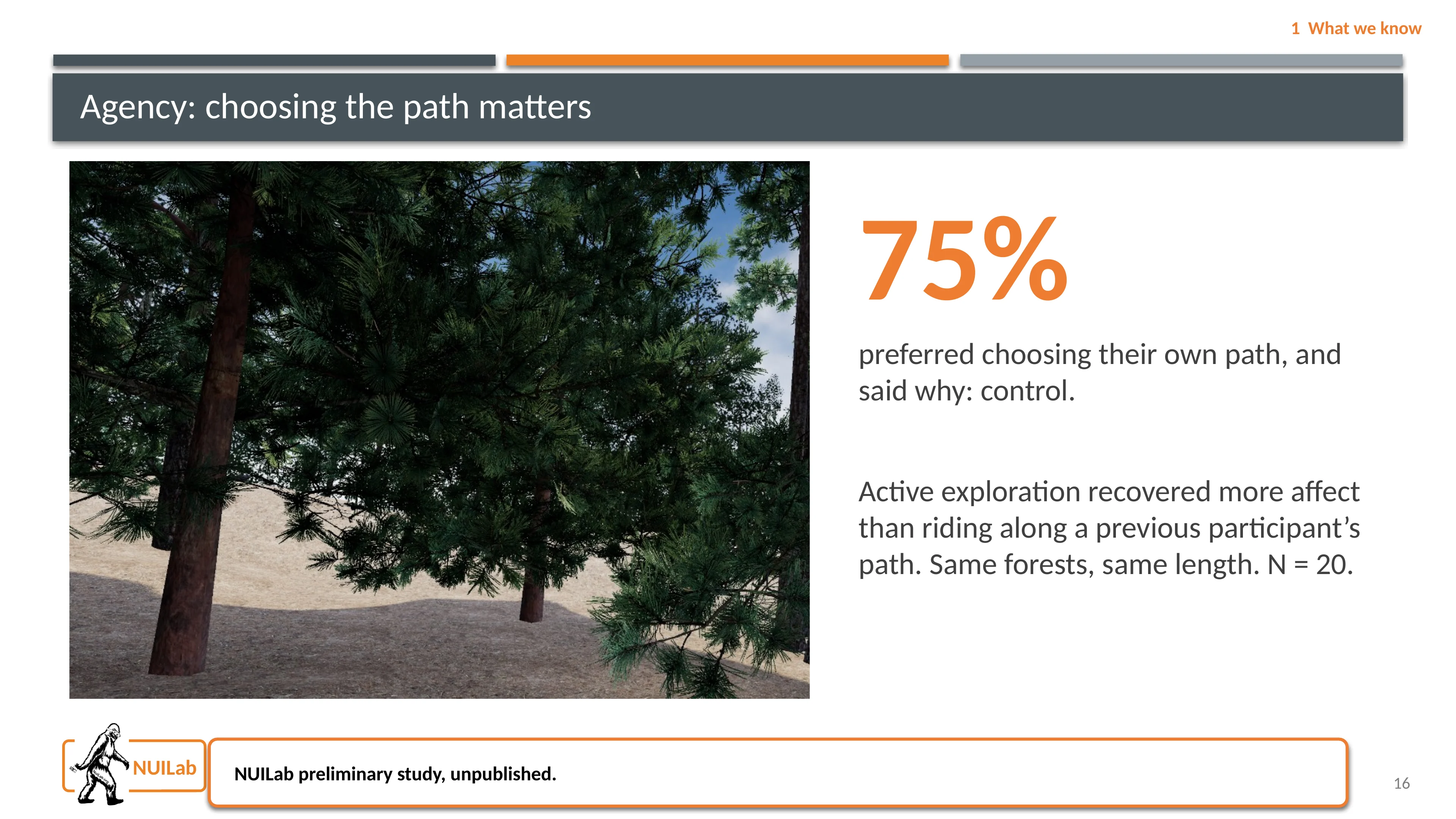
Agency: choosing the path matters
75%
preferred choosing their own path, and said why: control.
Active exploration recovered more affect than riding along a previous participant’s path. Same forests, same length. N = 20.
NUILab preliminary study, unpublished.
1 What we know
16
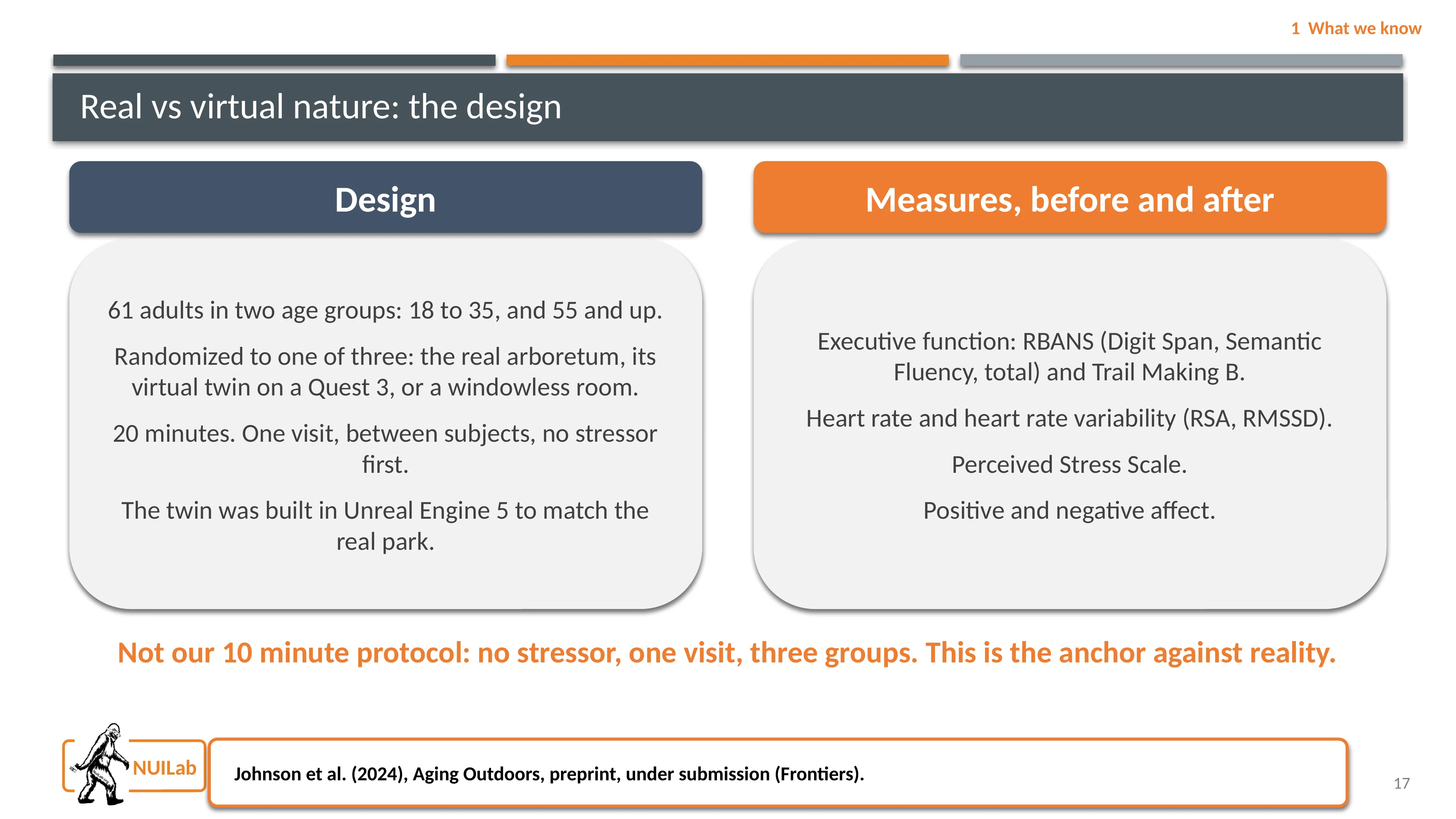
Real vs virtual nature: the design
Design
61 adults in two age groups: 18 to 35, and 55 and up.
Randomized to one of three: the real arboretum, its virtual twin on a Quest 3, or a windowless room.
20 minutes. One visit, between subjects, no stressor first.
The twin was built in Unreal Engine 5 to match the real park.
Measures, before and after
Executive function: RBANS (Digit Span, Semantic Fluency, total) and Trail Making B.
Heart rate and heart rate variability (RSA, RMSSD).
Perceived Stress Scale.
Positive and negative affect.
Not our 10 minute protocol: no stressor, one visit, three groups. This is the anchor against reality.
Johnson et al. (2024), Aging Outdoors, preprint, under submission (Frontiers).
1 What we know
17
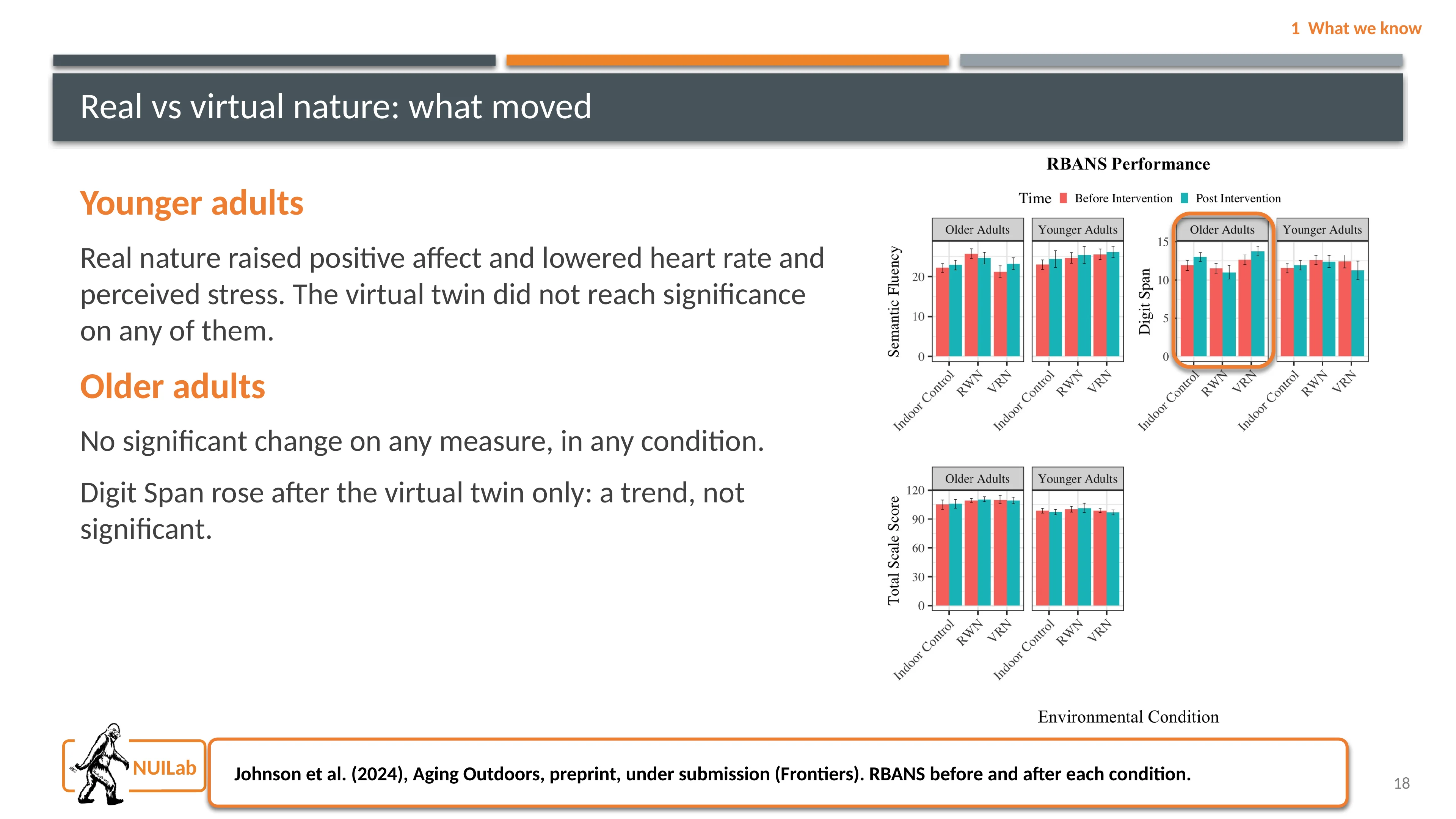
Real vs virtual nature: what moved
Younger adults
Real nature raised positive affect and lowered heart rate and perceived stress. The virtual twin did not reach significance on any of them.
Older adults
No significant change on any measure, in any condition.
Digit Span rose after the virtual twin only: a trend, not significant.
Johnson et al. (2024), Aging Outdoors, preprint, under submission (Frontiers). RBANS before and after each condition.
1 What we know
18
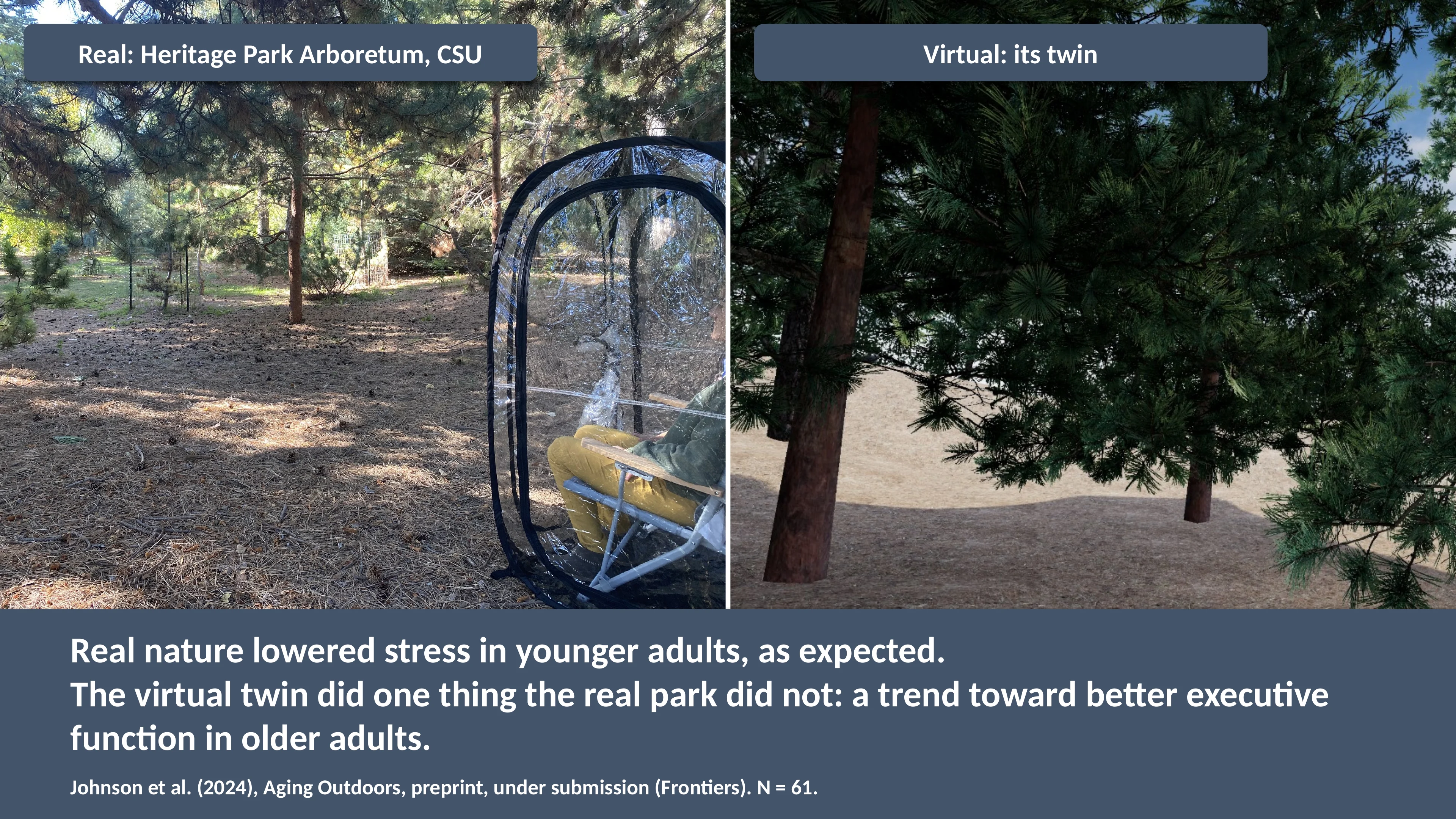
Real: Heritage Park Arboretum, CSU
Virtual: its twin
Real nature lowered stress in younger adults, as expected.
The virtual twin did one thing the real park did not: a trend toward better executive function in older adults.
Johnson et al. (2024), Aging Outdoors, preprint, under submission (Frontiers). N = 61.
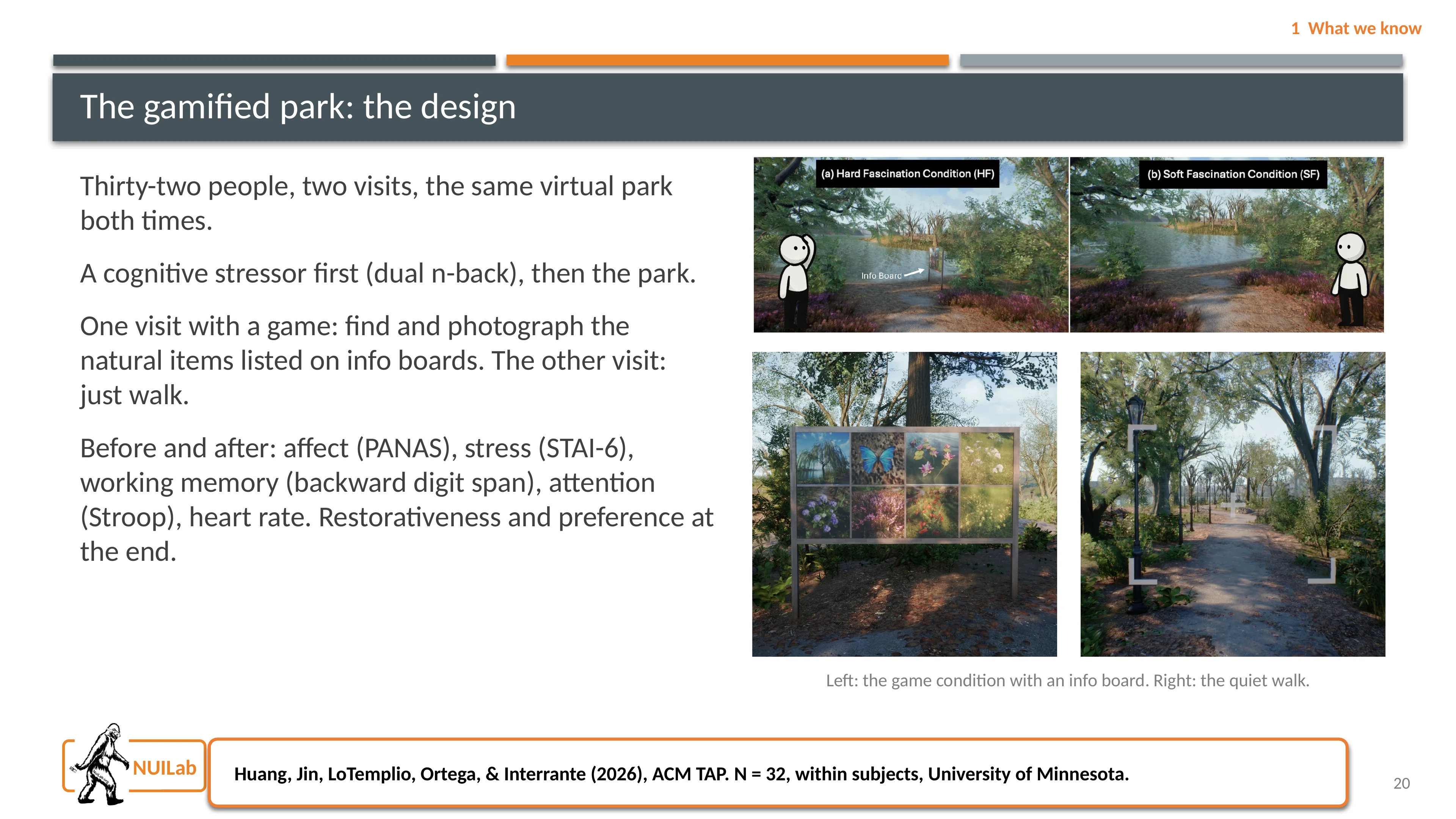
The gamified park: the design
Thirty-two people, two visits, the same virtual park both times.
A cognitive stressor first (dual n-back), then the park.
One visit with a game: find and photograph the natural items listed on info boards. The other visit: just walk.
Before and after: affect (PANAS), stress (STAI-6), working memory (backward digit span), attention (Stroop), heart rate. Restorativeness and preference at the end.
Left: the game condition with an info board. Right: the quiet walk.
Huang, Jin, LoTemplio, Ortega, & Interrante (2026), ACM TAP. N = 32, within subjects, University of Minnesota.
1 What we know
20
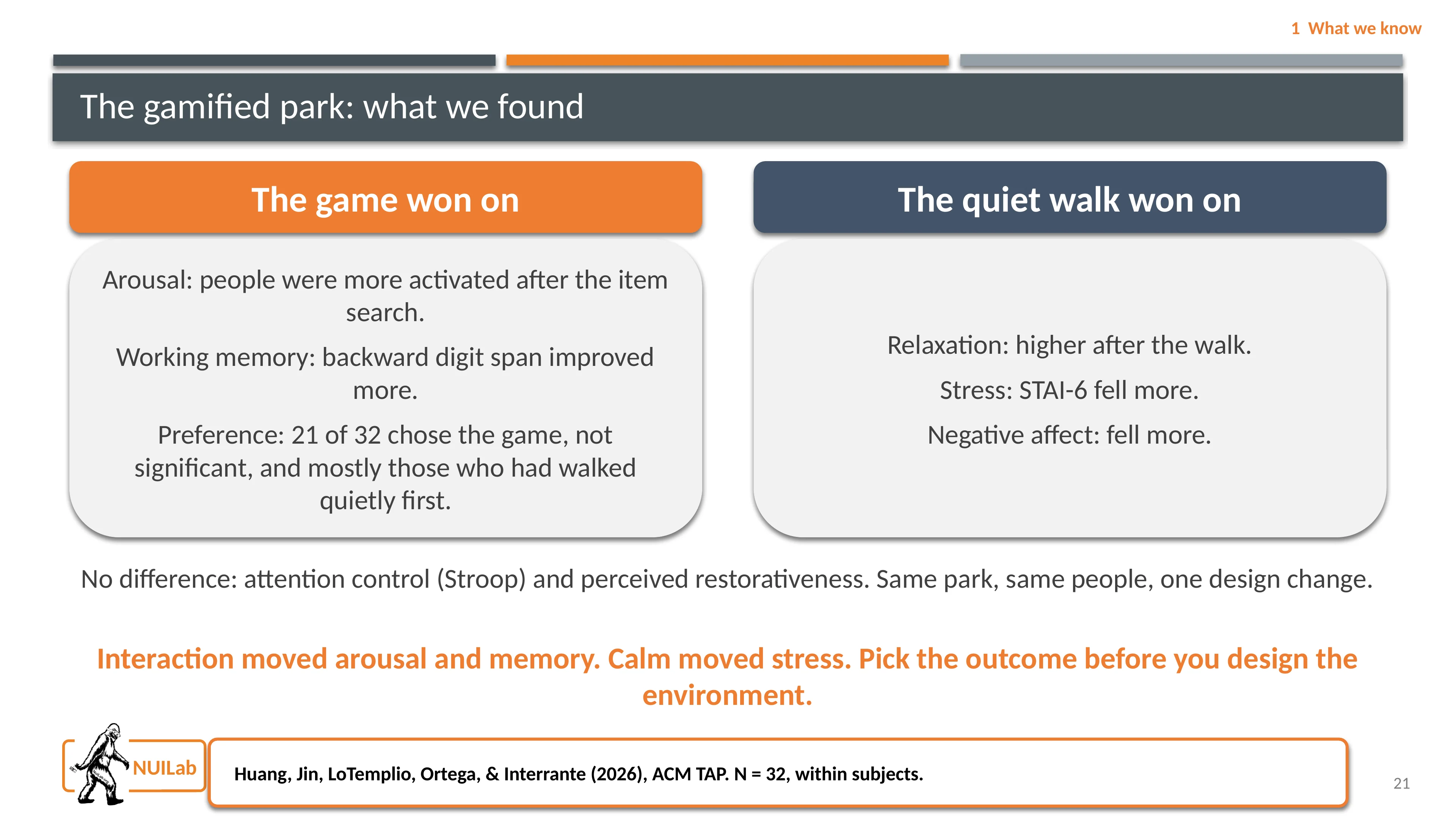
The gamified park: what we found
The game won on
Arousal: people were more activated after the item search.
Working memory: backward digit span improved more.
Preference: 21 of 32 chose the game, not significant, and mostly those who had walked quietly first.
The quiet walk won on
Relaxation: higher after the walk.
Stress: STAI-6 fell more.
Negative affect: fell more.
No difference: attention control (Stroop) and perceived restorativeness. Same park, same people, one design change.
Interaction moved arousal and memory. Calm moved stress. Pick the outcome before you design the environment.
Huang, Jin, LoTemplio, Ortega, & Interrante (2026), ACM TAP. N = 32, within subjects.
1 What we know
21
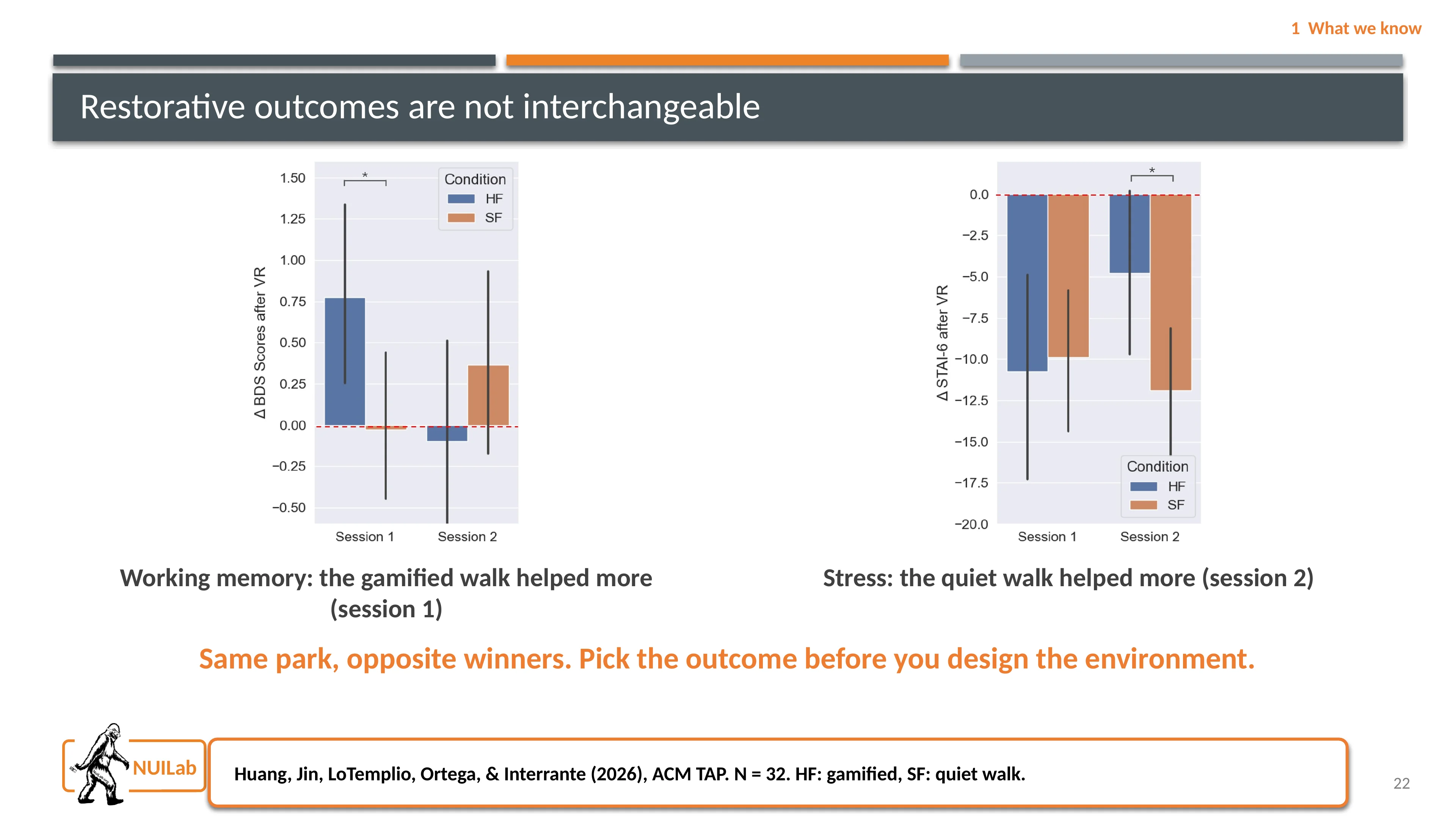
Restorative outcomes are not interchangeable
Working memory: the gamified walk helped more (session 1)
Stress: the quiet walk helped more (session 2)
Same park, opposite winners. Pick the outcome before you design the environment.
Huang, Jin, LoTemplio, Ortega, & Interrante (2026), ACM TAP. N = 32. HF: gamified, SF: quiet walk.
1 What we know
22
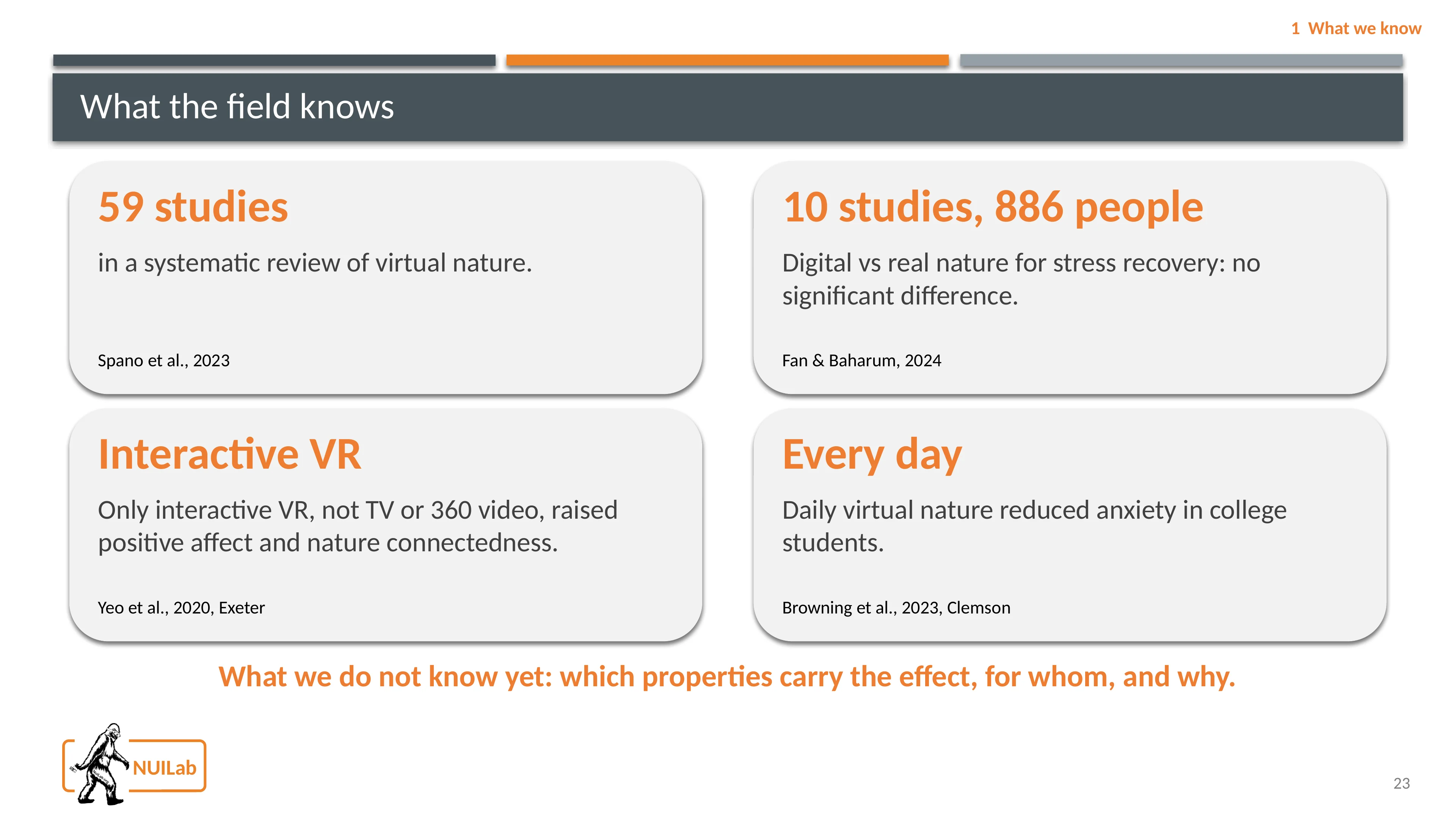
What the field knows
59 studies
in a systematic review of virtual nature.
Spano et al., 2023
10 studies, 886 people
Digital vs real nature for stress recovery: no significant difference.
Fan & Baharum, 2024
Interactive VR
Only interactive VR, not TV or 360 video, raised positive affect and nature connectedness.
Yeo et al., 2020, Exeter
Every day
Daily virtual nature reduced anxiety in college students.
Browning et al., 2023, Clemson
What we do not know yet: which properties carry the effect, for whom, and why.
1 What we know
23
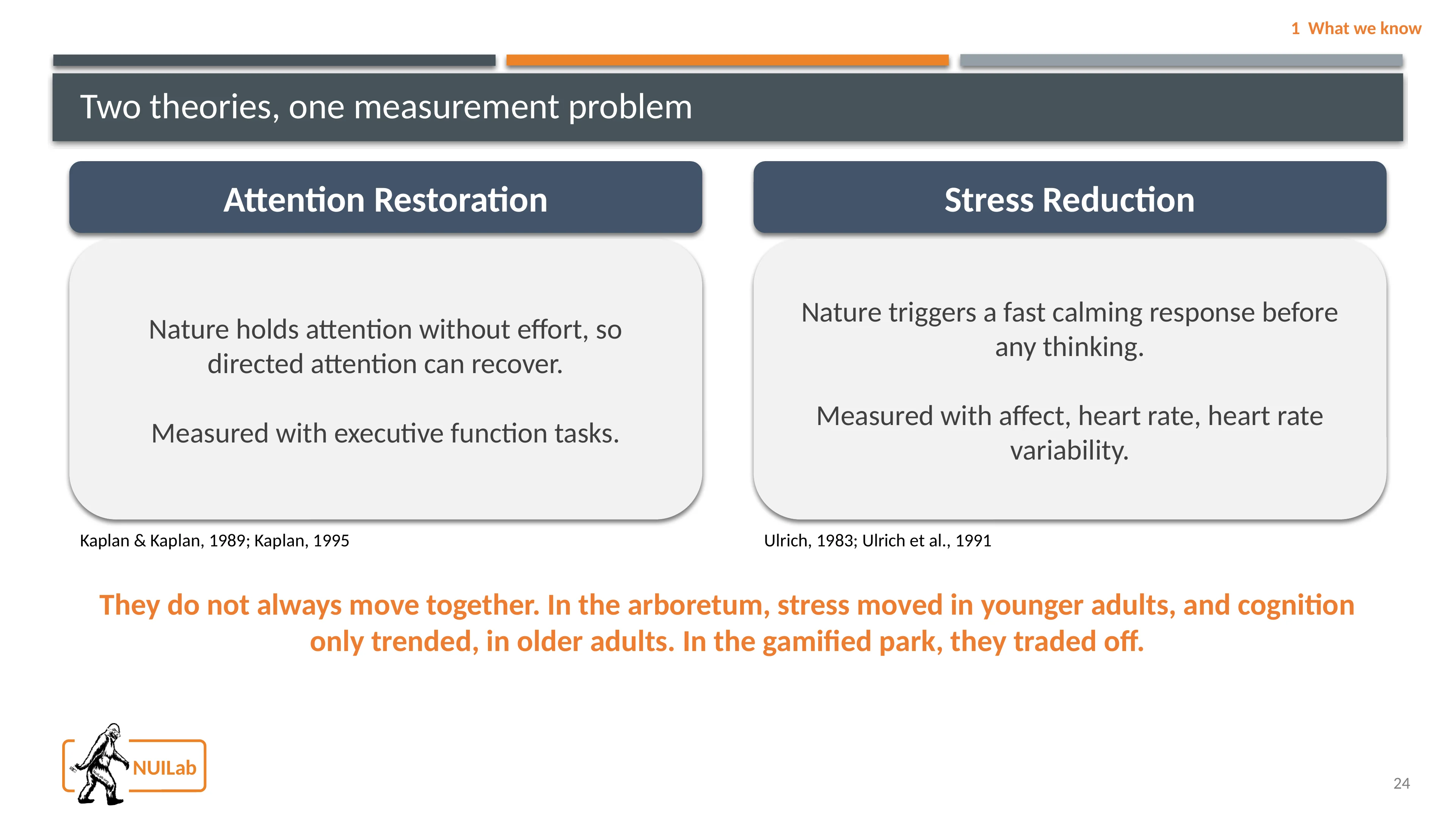
Two theories, one measurement problem
Attention Restoration
Nature holds attention without effort, so directed attention can recover.
Measured with executive function tasks.
Kaplan & Kaplan, 1989; Kaplan, 1995
Stress Reduction
Nature triggers a fast calming response before any thinking.
Measured with affect, heart rate, heart rate variability.
Ulrich, 1983; Ulrich et al., 1991
They do not always move together. In the arboretum, stress moved in younger adults, and cognition only trended, in older adults. In the gamified park, they traded off.
1 What we know
24
2
WHAT WE ARE MISSING
Open questions for the community
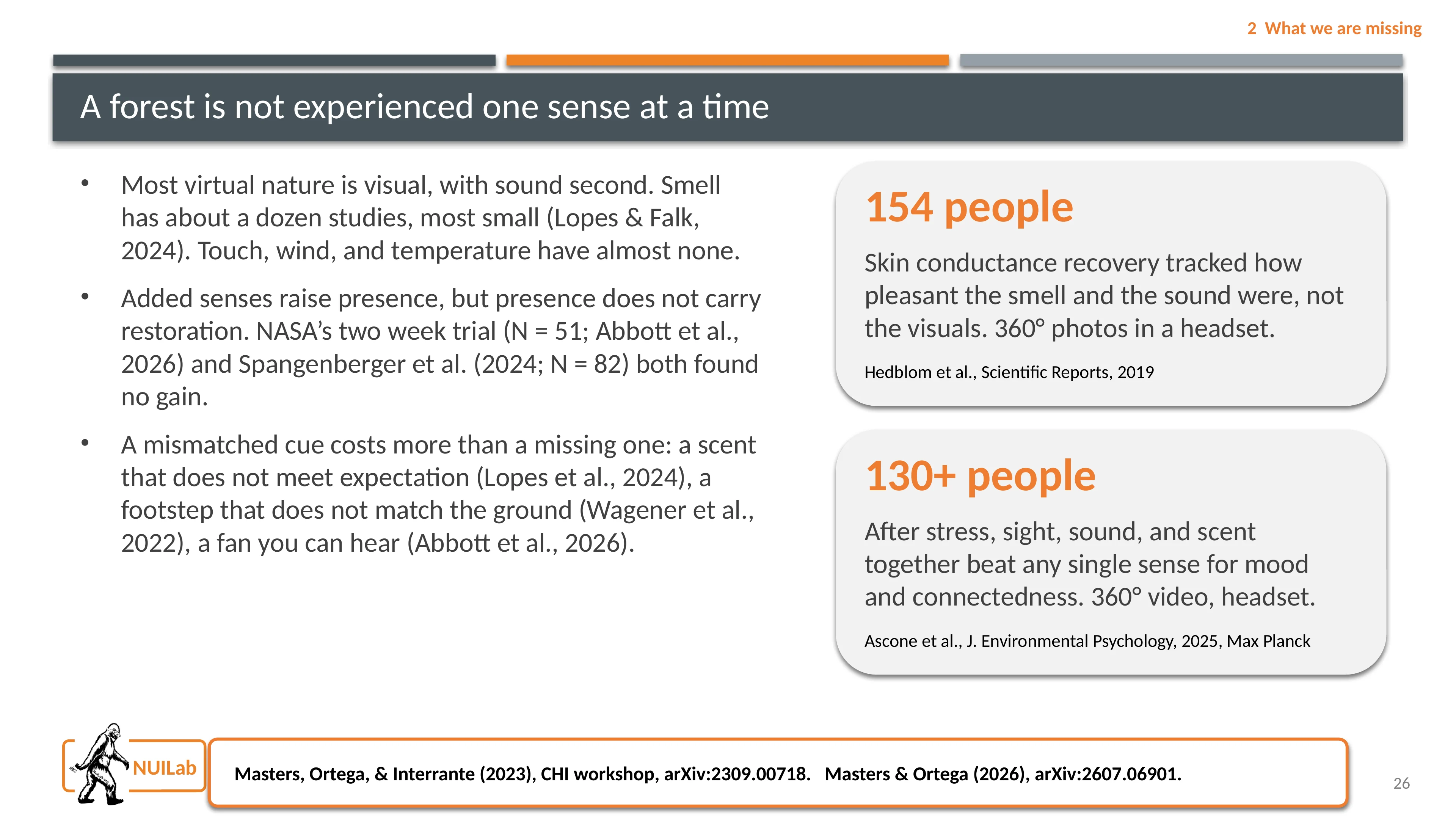
A forest is not experienced one sense at a time
Most virtual nature is visual, with sound second. Smell has about a dozen studies, most small (Lopes & Falk, 2024). Touch, wind, and temperature have almost none.
Added senses raise presence, but presence does not carry restoration. NASA’s two week trial (N = 51; Abbott et al., 2026) and Spangenberger et al. (2024; N = 82) both found no gain.
A mismatched cue costs more than a missing one: a scent that does not meet expectation (Lopes et al., 2024), a footstep that does not match the ground (Wagener et al., 2022), a fan you can hear (Abbott et al., 2026).
154 people
Skin conductance recovery tracked how pleasant the smell and the sound were, not the visuals. 360° photos in a headset.
Hedblom et al., Scientific Reports, 2019
130+ people
After stress, sight, sound, and scent together beat any single sense for mood and connectedness. 360° video, headset.
Ascone et al., J. Environmental Psychology, 2025, Max Planck
Masters, Ortega, & Interrante (2023), CHI workshop, arXiv:2309.00718. Masters & Ortega (2026), arXiv:2607.06901.
2 What we are missing
26
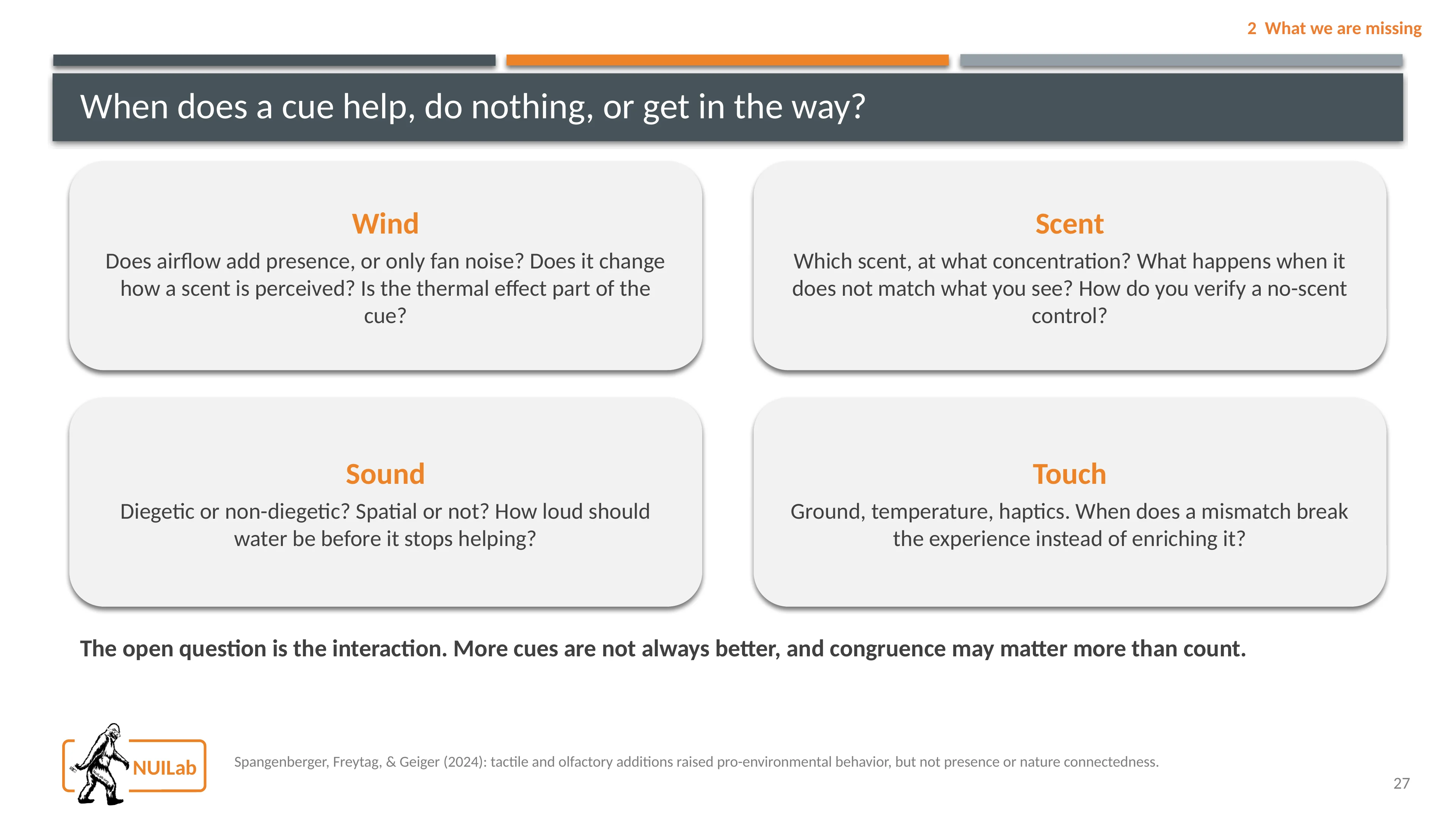
When does a cue help, do nothing, or get in the way?
Wind
Does airflow add presence, or only fan noise? Does it change how a scent is perceived? Is the thermal effect part of the cue?
Scent
Which scent, at what concentration? What happens when it does not match what you see? How do you verify a no-scent control?
Sound
Diegetic or non-diegetic? Spatial or not? How loud should water be before it stops helping?
Touch
Ground, temperature, haptics. When does a mismatch break the experience instead of enriching it?
The open question is the interaction. More cues are not always better, and congruence may matter more than count.
Spangenberger, Freytag, & Geiger (2024): tactile and olfactory additions raised pro-environmental behavior, but not presence or nature connectedness.
2 What we are missing
27
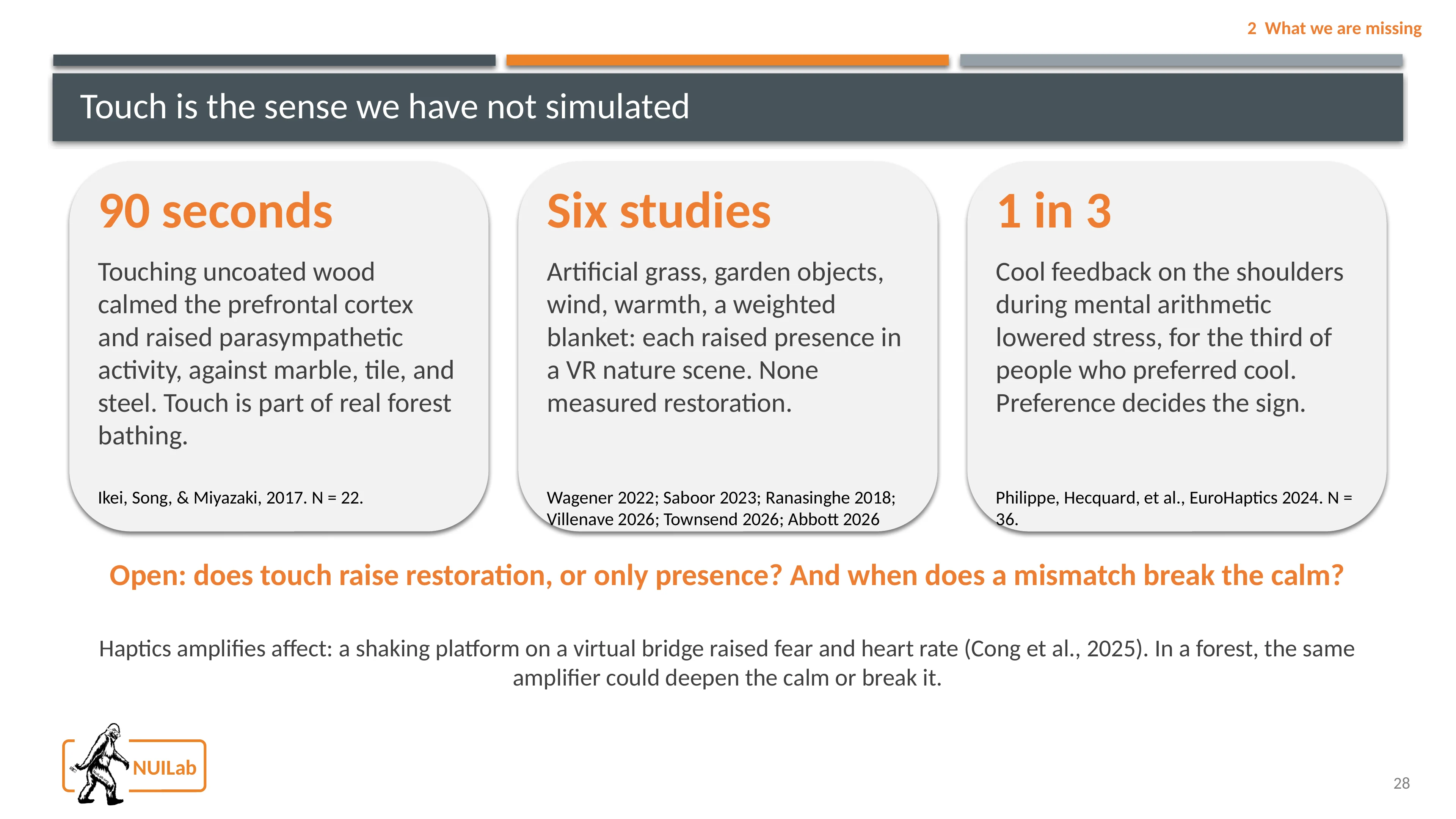
Touch is the sense we have not simulated
90 seconds
Touching uncoated wood calmed the prefrontal cortex and raised parasympathetic activity, against marble, tile, and steel. Touch is part of real forest bathing.
Ikei, Song, & Miyazaki, 2017. N = 22.
Six studies
Artificial grass, garden objects, wind, warmth, a weighted blanket: each raised presence in a VR nature scene. None measured restoration.
Wagener 2022; Saboor 2023; Ranasinghe 2018; Villenave 2026; Townsend 2026; Abbott 2026
1 in 3
Cool feedback on the shoulders during mental arithmetic lowered stress, for the third of people who preferred cool. Preference decides the sign.
Philippe, Hecquard, et al., EuroHaptics 2024. N = 36.
Open: does touch raise restoration, or only presence? And when does a mismatch break the calm?
Haptics amplifies affect: a shaking platform on a virtual bridge raised fear and heart rate (Cong et al., 2025). In a forest, the same amplifier could deepen the calm or break it.
2 What we are missing
28
Does individual preference play a role?
Does upbringing, where you grew up, play a role?
Do prior nature experience and access change the response?
Do we need virtual reality in all cases? What alternatives do we have?
For whom? Individual differences
2 What we are missing
29
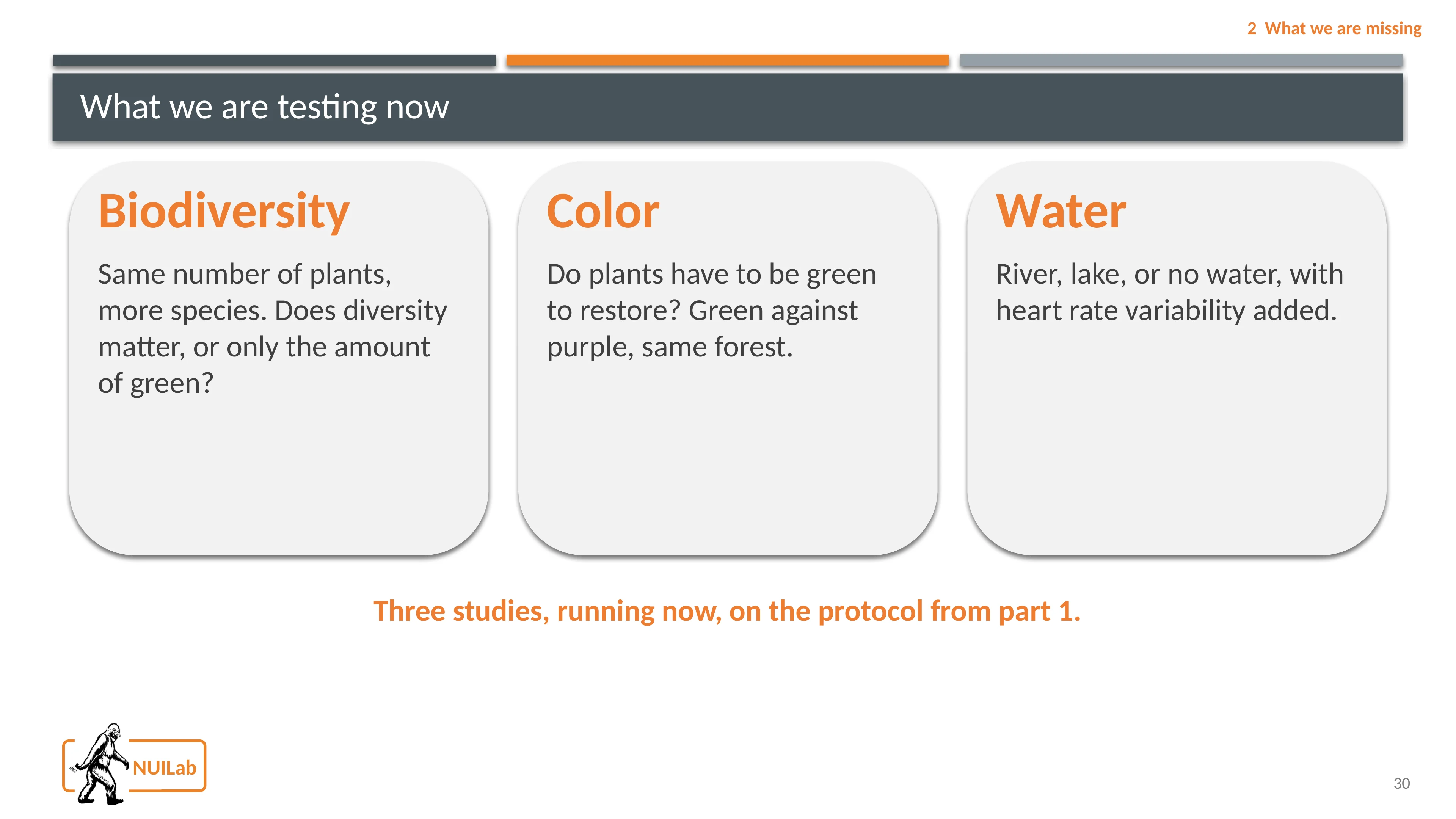
What we are testing now
2 What we are missing
Biodiversity
Same number of plants, more species. Does diversity matter, or only the amount of green?
Color
Do plants have to be green to restore? Green against purple, same forest.
Water
River, lake, or no water, with heart rate variability added.
Three studies, running now, on the protocol from part 1.
30
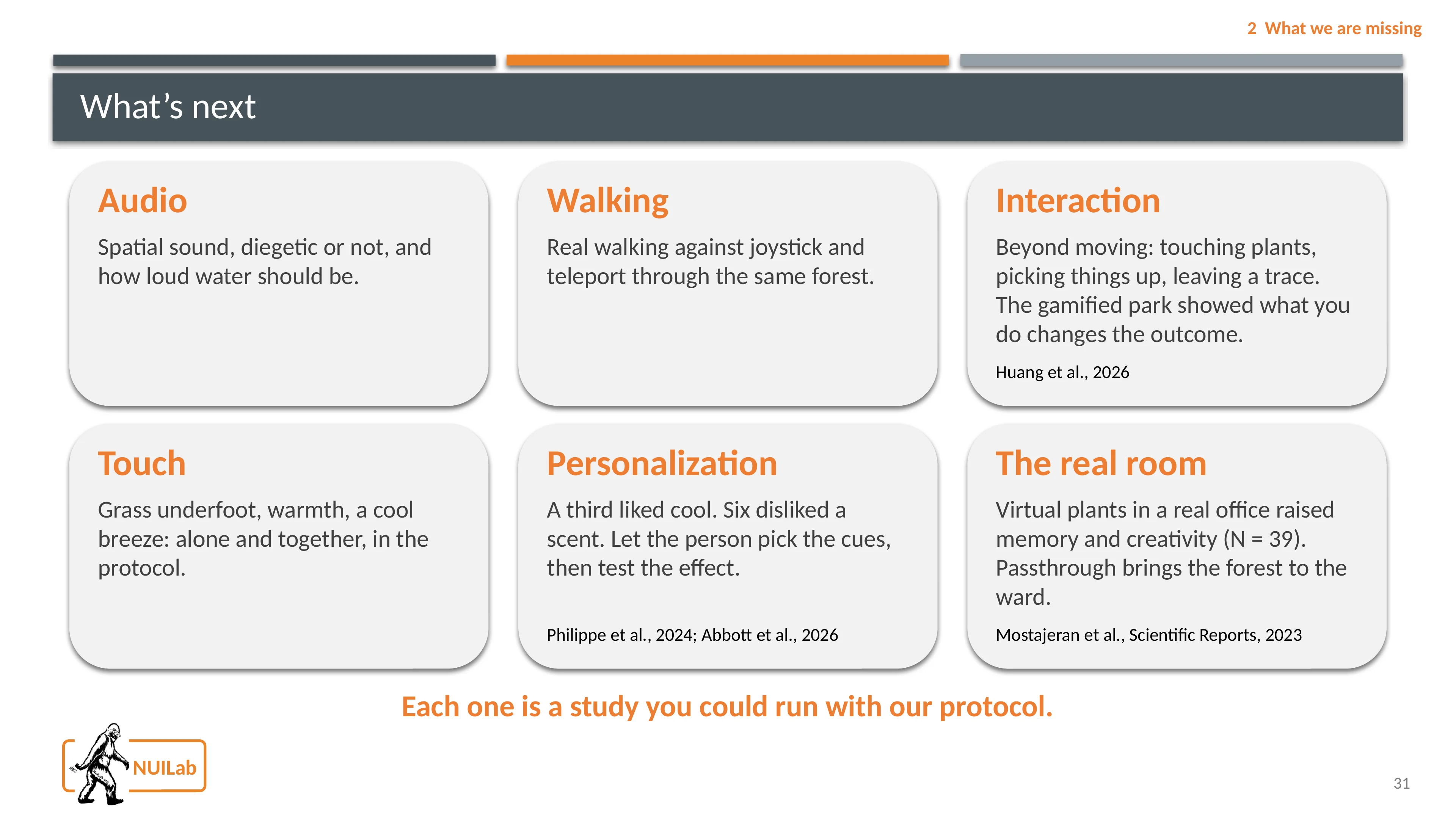
What’s next
Audio
Spatial sound, diegetic or not, and how loud water should be.
Walking
Real walking against joystick and teleport through the same forest.
Interaction
Beyond moving: touching plants, picking things up, leaving a trace. The gamified park showed what you do changes the outcome.
Huang et al., 2026
Touch
Grass underfoot, warmth, a cool breeze: alone and together, in the protocol.
Personalization
A third liked cool. Six disliked a scent. Let the person pick the cues, then test the effect.
Philippe et al., 2024; Abbott et al., 2026
The real room
Virtual plants in a real office raised memory and creativity (N = 39). Passthrough brings the forest to the ward.
Mostajeran et al., Scientific Reports, 2023
Each one is a study you could run with our protocol.
2 What we are missing
31
What the community can work on
Share a protocol: the same stressor, the same three timepoints, the same exposure length.
Share measures: restorativeness, affect, perceived stress, heart rate variability, executive function.
Share environments and data.
Replicate across labs and countries, with the same virtual forest.
Ortega, Interrante, LoTemplio, Masters, Nicoly, Borhani, Davalos, & Zielasko (2024), CSCW Positech workshop, arXiv:2411.06293.
2 What we are missing
32
3
WHY IT MATTERS
Beyond stress reduction
Perception: looking real is not feeling real
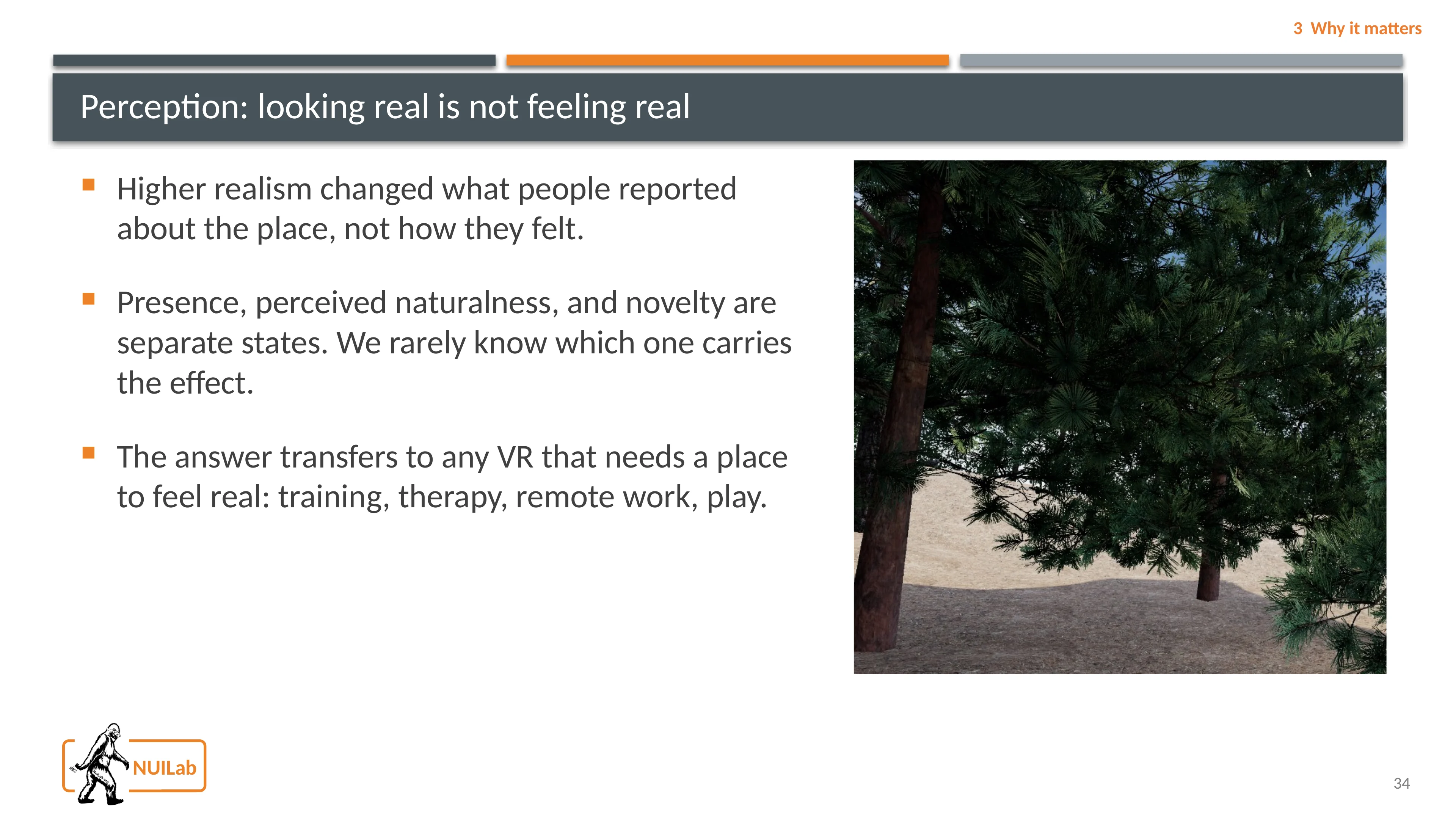
Higher realism changed what people reported about the place, not how they felt.
Presence, perceived naturalness, and novelty are separate states. We rarely know which one carries the effect.
The answer transfers to any VR that needs a place to feel real: training, therapy, remote work, play.
3 Why it matters
34
Why does it work? Perception is the untested link
Two perceptual states
Presence: the sense of being there, place illusion and plausibility (Slater, 2009). Measured with the iGroup Presence Questionnaire (Schubert et al., 2001).
Perceived naturalness: does the scene read as real nature, or as a rendering?
Both are measured, not manipulated, so they can be tested as the pathway from design to recovery.
Three tests we have designed
Plants: real, artificial, and virtual plants in the same office, through one passthrough headset. Are virtual plants judged closer to the real ones or the artificial ones?
Color: green against purple, same structure. Naturalness and novelty pull apart.
Wind and scent: alone and together, with congruence checked and fan noise held constant.
Our realism study: looking real changed the report, not the feeling. Whether presence or naturalness carries the effect is the next thing to measure.
Slater (2009), Phil. Trans. R. Soc. B 364:3549. Schubert, Friedmann, & Regenbrecht (2001), Presence 10(3):266.
3 Why it matters
35
Executive function, especially in older adults
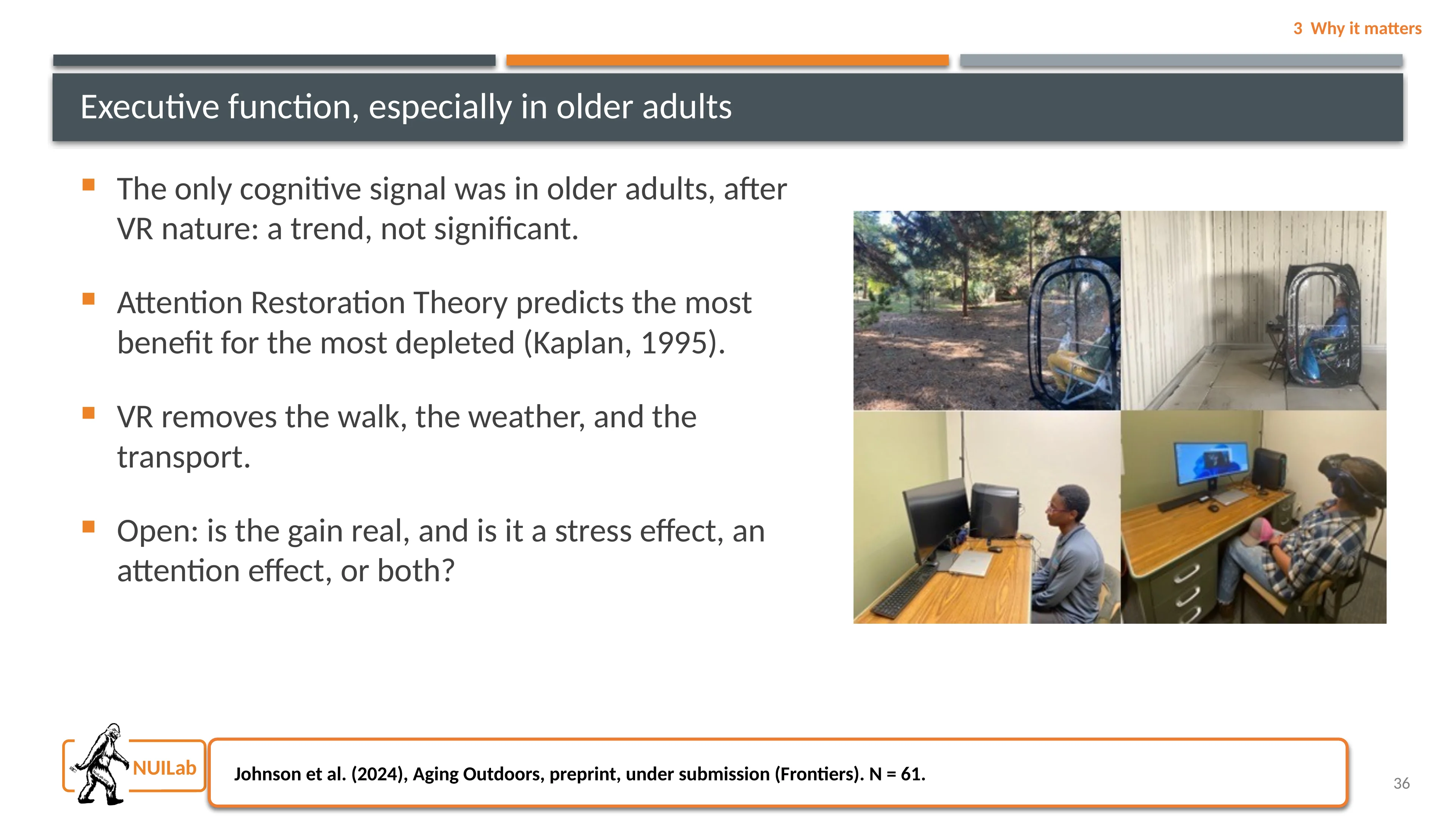
The only cognitive signal was in older adults, after VR nature: a trend, not significant.
Attention Restoration Theory predicts the most benefit for the most depleted (Kaplan, 1995).
VR removes the walk, the weather, and the transport.
Open: is the gain real, and is it a stress effect, an attention effect, or both?
Johnson et al. (2024), Aging Outdoors, preprint, under submission (Frontiers). N = 61.
3 Why it matters
36
Where it could go: care and clinical settings
VR nature has been tested before surgery (Subramaniam et al., 2025), during chemotherapy (Wilson & Scorsone, 2021; Scates et al., 2020) and dialysis (Hsieh & Li, 2022), and in long-term care (Blankenship, 2020; Chi et al., 2026).
Immersive headsets beat 2D nature on mental health outcomes (Yen et al., 2024).
In Chile: an early project on portable VR nature for children treated for burn injuries.
What a validated model would give a clinician: which environment, which senses, for whom, for how long.
Subramaniam et al., 2025; Wilson & Scorsone, 2021; Scates et al., 2020; Hsieh & Li, 2022; Blankenship, 2020; Chi et al., 2026; Yen et al., 2024.
3 Why it matters
37
Questions
How do wind, scent, sound, and touch combine, and when does a cue get in the way?
Which properties of a virtual forest matter, and for whom?
Why does a virtual forest restore us at all?
Can it sharpen attention, reach the clinic, and send people back outside?
Pick one. Our environments, protocol, and mistakes are yours.
fortega@colostate.edu https://nuilab.org
38
Acknowledgments
The Office of Naval Research DURIP program, grant N00014-24-1-2214.
The National Science Foundation, grants 2327569, 2238313, 2439474, and 2444132.
The Dan Marino Foundation.
Tifanie Bouchara, Florent Berthaut, Guillaume Loup, and the jf·XR 2026 organizers for the invitation.
nuilab.org



NUILab Website:
https://nuilab.org/
Contact Us:
fortega@colostate.edu
Thank you!